- NEWS AND VIEWS
Since 2020, snowfall has largely counterbalanced the melting of the Antarctic ice sheet. The atmospheric effect that causes this has been identified — and it’s temporary.
By
-
Jonathan Wille
-
Jonathan Wille is at the French National Centre for Scientific Research/Biogeosciences, University of Burgundy Europe, Dijon 21000, France.
-
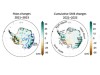
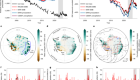
With record-breaking heatwaves, wildfires, a super El Niño and dwindling Arctic sea ice dominating the headlines, it might come as a surprise that loss of mass from the Antarctic ice sheet has essentially been on pause since about 2020. Writing in Nature, Wang et al.1 report that the cause is an atmospheric phenomenon that links warm seas in the Indian and Pacific Oceans with enhanced snowfall in Antarctica, counterbalancing ice mass lost to melting. Importantly, the authors found that the anomalous sea temperatures that are responsible for this trend occur roughly once every decade, so the Antarctic ice sheet looks set to return to losing mass in the next few years.
doi: https://doi.org/10.1038/d41586-026-02376-w
References
Wang, Y. et al. Nature https://doi.org/10.1038/s41586-026-10912-x (2026).
Article Google Scholar
Wang, Y., Wu, Q., Zhang, X. & Zhai, Z. Sci. Bull. 68, 3154–3157 (2023).
Article Google Scholar
Kolbe, M. et al. Commun. Earth & Environ. 7, 255 (2026).
Article Google Scholar
Wille, J. D. et al. Nature Rev. Earth Environ. 6, 178–192 (2025).
Article Google Scholar
Wille, J. D. et al. J. Clim. 37, 757–778 (2024).
Article Google Scholar
Blanchard-Wrigglesworth, E., Cox, T., Espinosa, Z. I. & Donohoe, A. Geophys. Res. Lett. 50, e2023GL104910 (2023).
Article Google Scholar
Walker, C. C. et al. Nature Geosci. 17, 1240–1248 (2024).
Article Google Scholar
Maclennan, M. L. et al. Commun. Earth Environ. 6, 369 (2025).
Article PubMed Google Scholar
King, M. A., Lyu, K. & Zhang, X. Nature Geosci. 16, 1128–1135 (2023).
Article Google Scholar
Reese, R. et al. Cryosphere 17, 3761–3783 (2023).
Article Google Scholar
Tamarin-Brodsky, T. & Kaspi, Y. Nature Geosci. 10, 908–913 (2017).
Article Google Scholar
Download references
Competing Interests
The author declares no competing interests.
Related Articles
-
 Read the paper: Multiyear tropical warm pool warming drives slowdown in Antarctic mass loss
-
 Artificial algal blooms could remove atmospheric carbon — but can they be used responsibly?
-
 Climate snapshots trapped in ancient ice tell a surprising story
-
See all News & Views
Subjects
Latest on:
- Climate change
- Climate sciences
- Environmental sciences
-
A global atmospheric methane record from a tropical ice core
Article
-
Heatwaves expose weak links in food systems
Correspondence
-
Europe must adapt to live with megafires
Correspondence
-
A global atmospheric methane record from a tropical ice core
Article
-
Multiyear tropical warm pool warming drives slowdown in Antarctic mass loss
Article
-
Heatwaves expose weak links in food systems
Correspondence
-
Europe must adapt to live with megafires
Correspondence
-

No single rule explains how climate affects carbon storage in tropical forests
News & Views
-

Why scientists should lead the shift away from AI mega data centres
Comment