The Dell Pro 7 13 2-in-1 is a 13.3-inch business convertible that starts at 1.38kg (3.04lb) and folds through laptop, tent, stand, and tablet modes on a 360-degree hinge. Our review unit, model P703260, is configured near the top of the range, with the 16-core Core Ultra 7 366H, 64GB of LPDDR5X-8533, a 1TB Gen5 self-encrypting SSD, and the 500-nit WUXGA touch display with pen support.

Key Takeaways
- The 16-core Core Ultra 7 366H matches or beats the same chip in a desktop on short runs. Cinebench 2026 multi core reached 3,657 against 3,601 on the Dell Pro 5 Micro desktop, 7-Zip ran 12 percent ahead of it, and the 2-in-1 finished 40 percent ahead of the 8-core Core Ultra 7 355 in the ThinkPad X1 2-in-1 Gen 11.
- Sustained load settles 21 percent below the burst score. Across a 30-minute Cinebench loop the 2-in-1 held about 2,900 points at a 2,082MHz mean clock against a 3,657 multi-core score, where the Pro 5 Micro sustained 3,352 with the same processor and the X1 2-in-1 held its full score.
- 64GB of memory runs local models the 32GB convertibles cannot load. The integrated graphics can address 47.6GB, enough to run a 35B coding agent and Qwen3.8 27B on a 13-inch convertible.
- The Gen5 SSD reads twice as fast as anything else here. The 1TB drive read at 13,846MB/s and wrote at 9,249MB/s, and its sequential reads are about double the drives on Gen4 links in every comparison system.
- This configuration costs $5,501, and memory drives the price. The 64GB memory option alone adds $1,610 to a convertible that starts at $2,301 on Dell.com.
Where the Pro 7 13 2-in-1 Sits
The Pro 7 13 2-in-1 is the convertible member of Dell’s Pro 7 business line, alongside the clamshell Pro 7 13 and the Dell Pro 7 14. Dell markets it with the line “Laptop performance. Tablet flexibility.” and builds it on Intel’s Core Ultra Series 3 processors, from the 8-core Core Ultra 5 325 and 335 through the 12-core Core Ultra 5 336H to the 8-core Core Ultra 7 365 and the 16-core Core Ultra 7 366H in our unit.
The 366H pairs four P-cores, eight E-cores, and four LP E-cores with a 4.8GHz maximum clock, integrated Intel Graphics, and a 50 TOPS NPU, and it carries vPro. Memory is soldered LPDDR5X-8533 in 16GB, 32GB, or 64GB, and storage options run from a 256GB Gen4 drive to 1TB and 2TB Gen5 drives with self-encryption. The display is a single choice on the 2-in-1: a 13.3-inch WUXGA touch panel rated at 500 nits and 100 percent sRGB with pen support.
The 2-in-1 also supports Intel’s hearing accessibility features for the PC, which we plan to cover on this system in a dedicated piece. Intel pairs Bluetooth LE Audio with Auracast broadcast audio on its Wi-Fi PCs and says the combination improves accessibility for hearing aids with laptops and assisted listening services. Our unit connects through Intel’s Wi-Fi 7 BE211 module, which is Bluetooth 6.
The 2-in-1 starts at $2,301 on Dell.com with the Core Ultra 5 335 and 16GB. Building our configuration adds $530 for the 366H, $1,610 for 64GB of memory, and $620 for the 1TB Gen5 drive, and Dell adds three years of ProSupport with onsite service automatically, which brought the total to $5,501 at the time of writing with the FHD IR camera, the fingerprint reader, and the smart card reader.
Build and Design
The chassis measures 300 x 216.3mm and tapers from 10.92mm at the front to 16.43mm at the rear, with a 17.95mm maximum, and Dell lists a starting weight of 1.38kg (3.04lb). The lid and palm rest are aluminum, and the bottom cover is magnesium. The 360-degree hinge supports laptop, tent, stand, and tablet modes, and the display supports an active pen.
The hinge is stiff enough to resist bounces when the 2-in-1 is used on a lap, which is firmer than the hinge on the ThinkPad X1 2-in-1 Gen 11, where a slight bounce tipped the display back. In tent mode, the Dell slides a little on a smooth surface when the touchscreen is tapped, and our unit did not ship with a pen.


The left side carries HDMI 2.1, a USB-A port, and two USB-C ports, with a smart card reader toward the front, and the right side carries a third USB-C port, the headset jack, and a Kensington wedge lock slot. Dell’s spec for this port option lists two Thunderbolt 4 ports at 40Gbps with DisplayPort 2.1 and Power Delivery, one USB-C port at 20Gbps, and one USB-A port at 5Gbps. Wireless is Intel Wi-Fi 7 BE211 qualified against Bluetooth 6.0, and Dell offers 4G and 5G modems on other configurations.


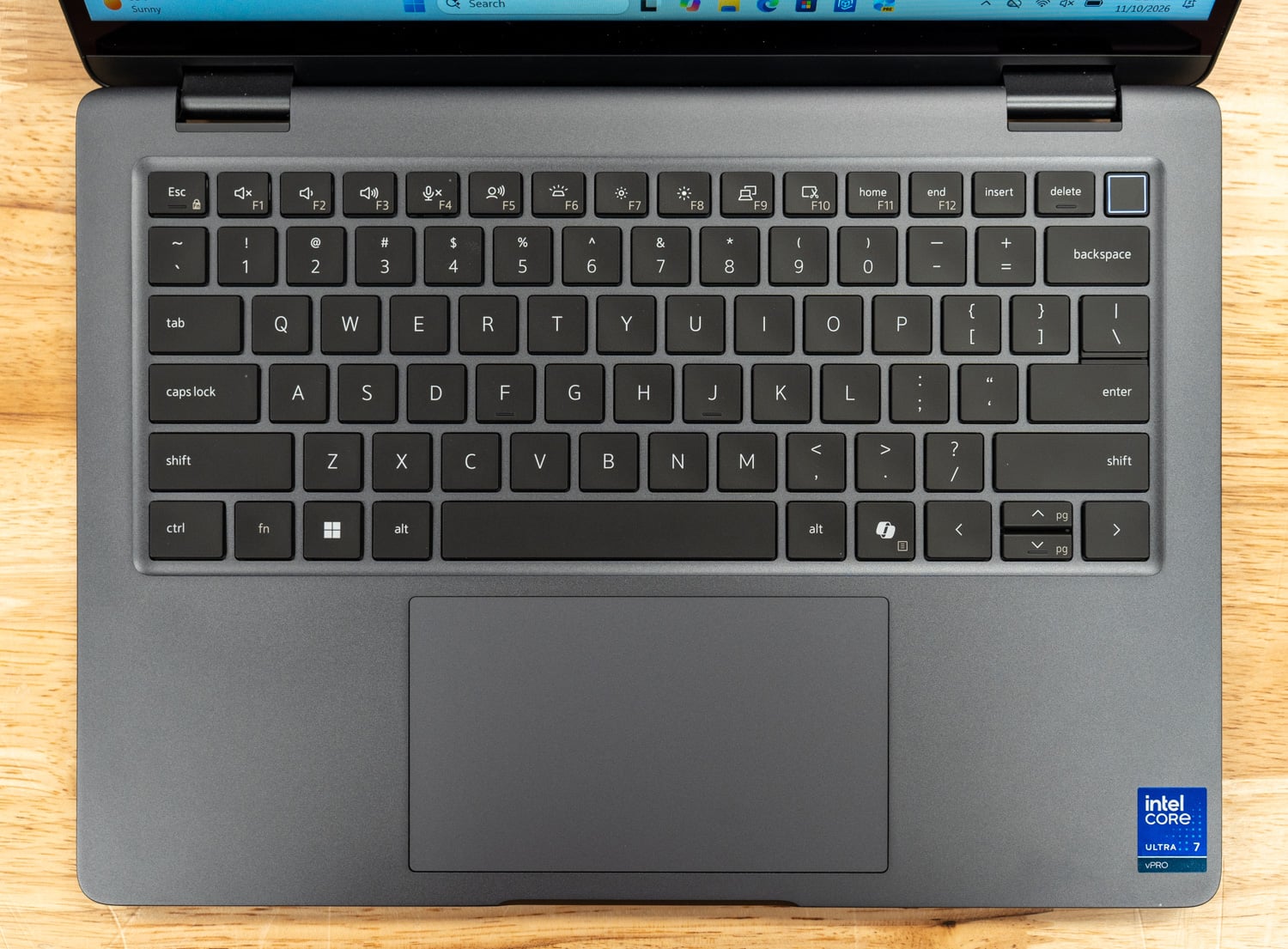
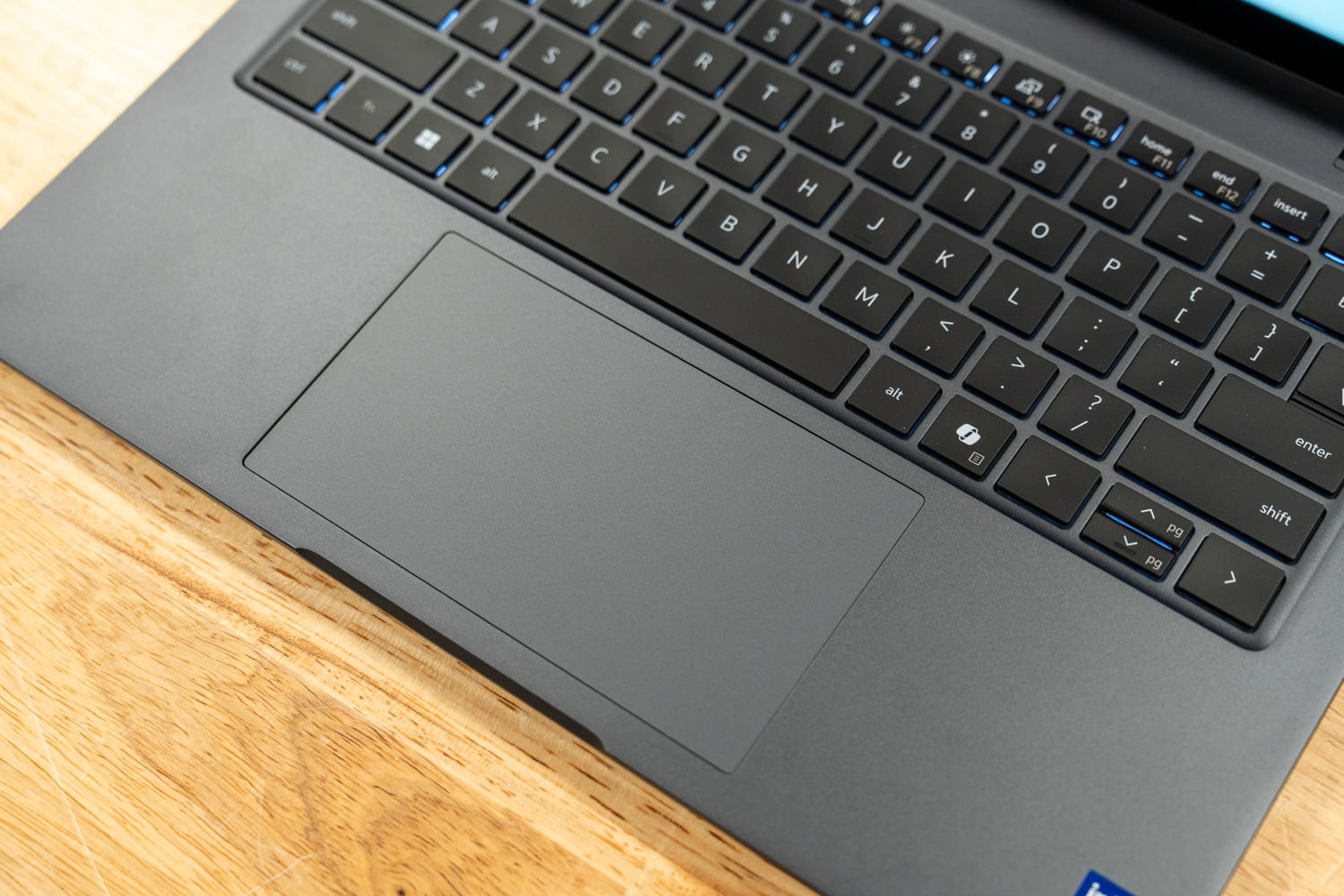
The keyboard has a mini-LED backlight and a Copilot key above a wide trackpad, and our unit adds a fingerprint reader. The FHD camera above the display has an IR sensor for Windows Hello, presence detection, temporal noise reduction, and a physical shutter. Security covers a FIPS 140-3 certified TPM, quantum-resistant BIOS verification, and a self-encrypting SSD. The panel tops out at 1920×1200, and we have not measured its brightness or battery life yet.

Six captive Phillips screws hold the bottom cover, and it comes off the same way as on most Dell notebooks. With the memory soldered, the M.2 SSD is the main replaceable part inside, and Dell also made the USB-C ports replaceable, each held in place by Phillips screws as on select other Dell models.
With the bottom cover off, our unit shows a single fan and heat pipe over the processor, an M.2 Wi-Fi card, and an M.2 SSD under a shield at the right edge. The 55.8Wh battery spans the front of the chassis between the two speakers. The battery supports ExpressCharge and ExpressCharge Boost from the 65W USB-C GaN adapter.


Dell Pro 7 13 2-in-1 Specifications
| Specification | Dell Pro 7 13 2-in-1 (as tested) |
|---|---|
| Platform | |
| Model | Dell Pro 7 13 2-in-1 (P703260) |
| Processor | Intel Core Ultra 7 366H vPro, 16 cores (4 P-cores, 8 E-cores, 4 LP E-cores), up to 4.8GHz |
| NPU | Intel AI Boost, 50 TOPS |
| Graphics | Intel Graphics (integrated), 47.6GB GPU-usable as tested |
| Memory | 64GB LPDDR5X-8533, soldered |
| Storage | 1TB M.2 Gen5 x4 TLC SED |
| Operating System | Windows 11 Pro |
| Display | |
| Panel | 13.3-inch 16:10 WUXGA (1920×1200) touch, anti-reflective |
| Brightness and Color | 500 nits 100% sRGB |
| Pen | Active pen support (pen not included with our unit) |
| Connectivity | |
| Ports | 2x Thunderbolt 4 (40Gbps, DisplayPort 2.1, Power Delivery) 1x USB-C 20Gbps (DisplayPort 1.4, Power Delivery) 1x USB-A 5Gbps 1x HDMI 2.1 1x headset jack |
| Wireless | Intel Wi-Fi 7 BE211 Bluetooth 6.0 qualified |
| Input and Security | |
| Camera | FHD HDR with IR, presence detection, shutter |
| Keyboard | Mini-LED backlit, Copilot key |
| Security | FIPS 140-3 TPM Fingerprint reader Smart card reader Quantum-resistant BIOS verification Self-encrypting SSD |
| Power and Physical | |
| Battery | 55.8Wh 3-cell, ExpressCharge Boost |
| Charging | 65W USB-C GaN adapter |
| Dimensions | 300 x 216.3 x 10.92 to 16.43mm, 17.95mm maximum (11.80 x 8.50 x 0.42 to 0.64in) |
| Weight | Starting at 1.38kg (3.04lb) |
| Materials | Aluminum lid and palm rest, magnesium bottom cover |
| Warranty | ProSupport with onsite service after remote diagnosis, 36 months |
| Price as Tested | $5,501 (Dell.com) |
Test Setup and Methodology
Our review unit runs the Core Ultra 7 366H with integrated Intel Graphics, 64GB of LPDDR5X-8533, and a 1TB Gen5 SSD on Windows 11 Pro, with benchmarks tested on the Best Performance power mode. We ran the suite while plugged in, on BIOS 2.4.2 and Intel graphics driver 32.0.101.8991, with Dell Optimizer set to its ultra performance mode.
Results come from full, Peak-profile runs of sr-client, our scripted client benchmark suite, with Windows power mode at Best performance, the display at 50 percent brightness, sleep timers off, and VBS and Memory Integrity left as shipped. The suite could not read a CPU temperature sensor on this system, so it used fixed cool-down pauses between tests, and our thermal analysis relies on clocks and scores.
The Lenovo ThinkPad X1 2-in-1 Gen 11 is the closest rival, a 14-inch business convertible with the 8-core Core Ultra 7 355 and 32GB. The Dell Pro 5 Micro runs the same Core Ultra 7 366H and 64GB in a desktop chassis, which isolates what the convertible’s cooling costs. The Dell Pro 7 14 brings AMD’s 12-core Ryzen AI 9 HX PRO 470 with Radeon 890M graphics, and the Lenovo ThinkPad X9-15p Gen 1 adds the 16-core Core Ultra X7 358H with Arc B390 graphics.
| Configuration | CPU | Memory | GPU | Boot Drive | sr-client |
|---|---|---|---|---|---|
| Dell Pro 7 13 2-in-1 (P703260) | Core Ultra 7 366H, 16 cores | 64GB LPDDR5X-8533 | Intel Graphics, 47.6GB usable | 1TB SK hynix, PCIe Gen5 | 1.13 |
| Lenovo ThinkPad X1 2-in-1 Gen 11 | Core Ultra 7 355, 8 cores | 32GB LPDDR5X-7467 | Intel Graphics, 18.1GB usable | 512GB Samsung, PCIe Gen4 | 1.13 |
| Dell Pro 7 14 (P714265) | Ryzen AI 9 HX PRO 470, 12 cores | 64GB LPDDR5X-8000 | Radeon 890M, 47.8GB usable | 1TB Samsung, PCIe Gen4 | 1.12 |
| Lenovo ThinkPad X9-15p Gen 1 | Core Ultra X7 358H, 16 cores | 32GB LPDDR5X-9600 | Arc B390, 18.1GB usable | 1TB UMIS, PCIe Gen4 | 1.13 |
| Dell Pro 5 Micro (P5M1260) | Core Ultra 7 366H, 16 cores | 64GB DDR5-5600 | Intel Graphics, 47.6GB usable | 1TB Sandisk SN8050S | 1.13 |
Local AI Performance
Local AI runs on the 366H’s integrated Intel Graphics and shared memory, and the 64GB configuration matters more here than the processor. The suite measured 47.6GB of GPU-usable memory, which opens the larger model tiers in our tests: a 35B coding agent and Qwen3.8 27B serving both ran, where the 32GB ThinkPads in this group stop at 18.1GB. The graphics core leads the X1 2-in-1 by 10 percent in MLPerf Client and by about 20 percent in four-request serving. It trails the Arc B390 in MLPerf Client, RAG, and serving, and it trails the Radeon 890M in RAG, serving, and image generation while leading it in MLPerf Client.
MLPerf Client v2.0
| MLPerf Client v2.0 | Dell Pro 7 13 2-in-1 (Ultra 7 366H, 64GB) | Lenovo ThinkPad X1 2-in-1 Gen 11 (Ultra 7 355, 32GB) | Dell Pro 7 14 (Ryzen AI 9 HX PRO 470, Radeon 890M) | Lenovo ThinkPad X9-15p Gen 1 (X7 358H, Arc B390, 32GB) | Dell Pro 5 Micro desktop (Ultra 7 366H, 64GB) |
|---|---|---|---|---|---|
| Llama 3.1 8B, time to first token (s, lower is better) | 0.49 | 0.53 | 3.15 | 0.20 | 0.54 |
| Llama 3.1 8B, token rate (tokens/s) | 23.7 | 21.6 | 18.0 | 27.3 | 17.8 |
| Phi-4-mini, time to first token (s, lower is better) | 0.40 | 0.43 | 1.90 | 0.18 | 0.42 |
| Phi-4-mini, token rate (tokens/s) | 34.6 | 31.4 | 29.5 | 41.7 | 27.6 |
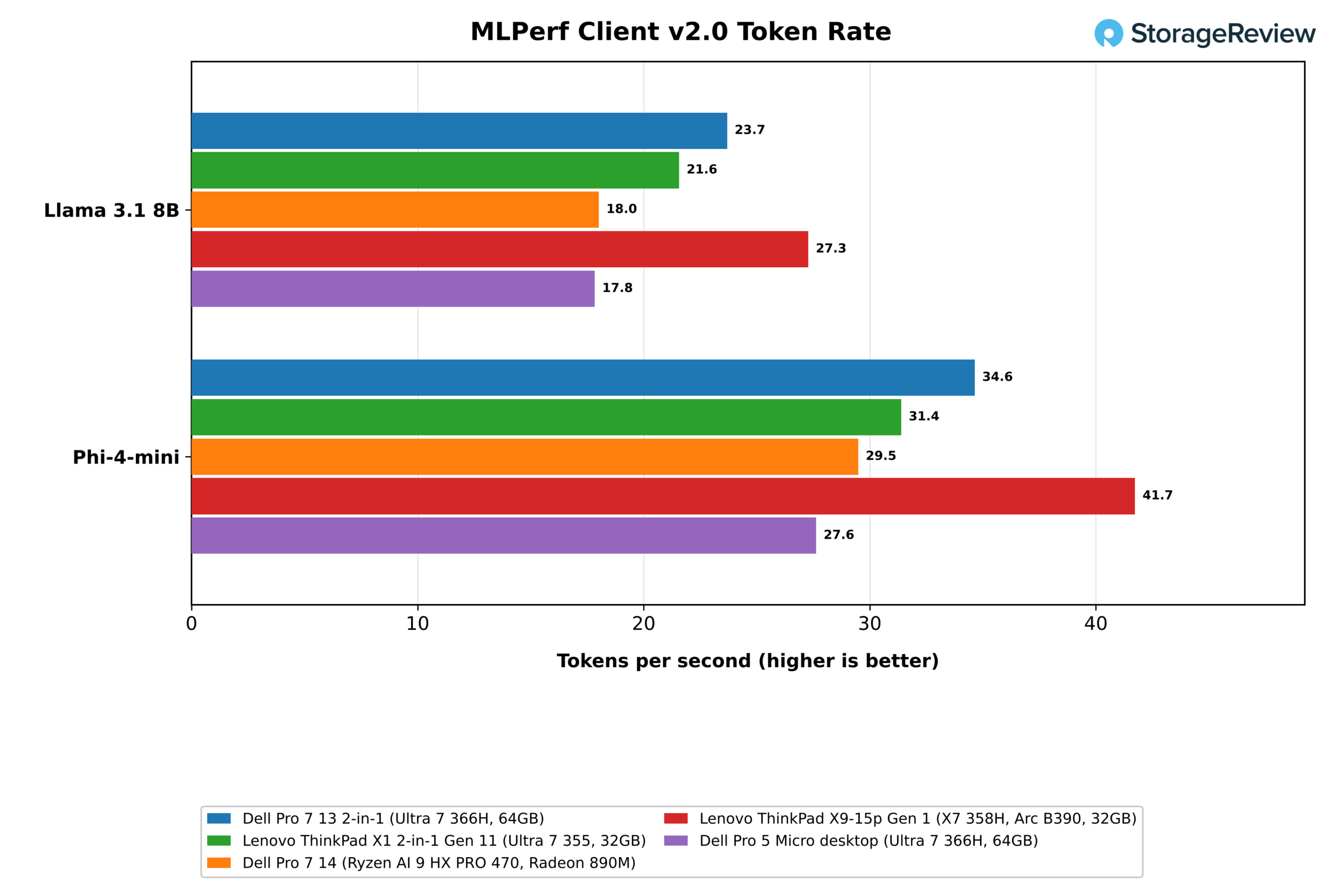
MLPerf Client runs through OpenVINO on the Intel systems and through Windows ML with DirectML on the Dell Pro 7 14, so the columns compare engines as well as hardware. The Pro 7 13 2-in-1 generated 23.7 tokens per second on Llama 3.1 8B and 34.6 on Phi-4-mini. On Llama 3.1 8B, that is 10 percent ahead of the X1 2-in-1 and 33 percent ahead of the same 366H in the Pro 5 Micro, and the lead over the Pro 5 Micro on Phi-4-mini is 25 percent. The X9-15p’s Arc B390 leads at 27.3 tokens per second.
Model Loading and the Coding Agent
| gpt-oss:20b (Ollama 0.40.3) | Dell Pro 7 13 2-in-1 (Ultra 7 366H, 64GB) | Lenovo ThinkPad X1 2-in-1 Gen 11 (Ultra 7 355, 32GB) | Dell Pro 7 14 (Ryzen AI 9 HX PRO 470, Radeon 890M) | Lenovo ThinkPad X9-15p Gen 1 (X7 358H, Arc B390, 32GB) | Dell Pro 5 Micro desktop (Ultra 7 366H, 64GB) |
|---|---|---|---|---|---|
| gpt-oss:20b cold load to first token (s, lower is better) | 6.46 | 10.40 | 10.94 | 8.63 | 7.29 |
| gpt-oss:20b warm load to first token (s, lower is better) | 4.64 | 9.80 | 5.14 | 8.01 | 4.94 |
| Coding agent, successful runs (of 3) | 3 | 2 | 2 | 3 | 1 |
| Coding agent, tests passing (of 11) | 11 | 11 | 11 | 11 | 8 |
| Coding agent, wall time (s, lower is better) | 1124 | 392 | 1328 | 374 | 891 |
| Coding agent, generation rate (tokens/s) | 14.2 | 12.5 | 20.2 | 18.3 | 13.6 |
| Speedometer slowdown beside the agent (x, lower is better) | 1.25 | 1.18 | 1.91 | 1.26 | 1.40 |
The Pro 7 13 2-in-1 loaded gpt-oss:20b in 6.46 seconds cold and 4.64 seconds warm, the fastest cold load in this group, which reflects its Gen5 SSD. It passed all three coding agent runs at the 64K tier at 14.2 tokens per second, and its median 1,124-second wall time reflects long multi-round runs. With 47.6GB available, it also ran the larger tier, passing all three runs on the 35B Qwen3.6 model at 25.5 tokens per second, a model the 32GB ThinkPads cannot load.
With Speedometer running beside the agent, the browser score slowed 1.25 times, close to the X9-15p’s 1.26 times and between the 1.18 times on the X1 2-in-1 and the 1.40 times on the Pro 5 Micro. The agent slowed to 1.13 times in that pairing and generated 14.0 tokens per second while the browser test ran.
RAG and LLM Serving
| RAG (Ollama 0.40.3) | Dell Pro 7 13 2-in-1 (Ultra 7 366H, 64GB) | Lenovo ThinkPad X1 2-in-1 Gen 11 (Ultra 7 355, 32GB) | Dell Pro 7 14 (Ryzen AI 9 HX PRO 470, Radeon 890M) | Lenovo ThinkPad X9-15p Gen 1 (X7 358H, Arc B390, 32GB) | Dell Pro 5 Micro desktop (Ultra 7 366H, 64GB) |
|---|---|---|---|---|---|
| Ingest, passages per second | 44.4 | 43.1 | 52.3 | 83.6 | 43.2 |
| Ingest, embedding rate (tokens/s) | 7,193 | 6,980 | 8,465 | 13,543 | 6,995 |
| Answer, generation rate (tokens/s) | 35.6 | 34.9 | 42.2 | 48.7 | 32.2 |
| Answer, time to first token p50 (s, lower is better) | 1.41 | 1.52 | 1.43 | 0.84 | 1.54 |
| Question to answer p50 (s, lower is better) | 1.57 | 1.69 | 1.58 | 0.98 | 1.71 |
The RAG test embeds 20,963 SQuAD passages and answers with Phi-4-mini. The Pro 7 13 2-in-1 ingested 44.4 passages per second and generated answers at 35.6 tokens per second, with a median of 1.57 seconds from question to answer, in line with the X1 2-in-1. The Dell Pro 7 14 is 18 percent faster on ingest at 52.3 passages per second, and the X9-15p is 88 percent faster at 83.6.
| llama.cpp server, Ministral 3 | Dell Pro 7 13 2-in-1 (Ultra 7 366H, 64GB) | Lenovo ThinkPad X1 2-in-1 Gen 11 (Ultra 7 355, 32GB) | Dell Pro 7 14 (Ryzen AI 9 HX PRO 470, Radeon 890M) | Lenovo ThinkPad X9-15p Gen 1 (X7 358H, Arc B390, 32GB) | Dell Pro 5 Micro desktop (Ultra 7 366H, 64GB) |
|---|---|---|---|---|---|
| Ministral 3 3B, 1 request, output (tokens/s) | 14.8 | 14.0 | 18.3 | 22.8 | 12.9 |
| Ministral 3 3B, 4 requests, output (tokens/s) | 30.6 | 25.2 | 45.3 | 39.1 | 29.5 |
| Ministral 3 3B, 1 request, time to first token (ms, lower is better) | 13,869 | 15,248 | 4,595 | 4,349 | 12,403 |
| Ministral 3 8B, 1 request, output (tokens/s) | 9.9 | 9.7 | 13.4 | 16.5 | 9.2 |
| Ministral 3 8B, 4 requests, output (tokens/s) | 17.1 | 14.3 | 29.0 | 25.6 | 17.4 |
| Ministral 3 8B, 1 request, time to first token (ms, lower is better) | 21,947 | 23,718 | 9,154 | 7,168 | 19,984 |
On the llama.cpp server, the 2-in-1 delivered 14.8 tokens per second to one user on Ministral 3 3B and 30.6 across four requests, and 9.9 and 17.1 on the 8B model. Prompt processing is the weak point of this graphics core, with a median of 13.9 seconds to first token on the 3B model and 21.9 seconds on the 8B model, against 4.6 and 9.2 seconds on the Radeon 890M in the Dell Pro 7 14.
Qwen3.8 27B fit in the 2-in-1’s 47.6GB and ran at 2.63 tokens per second for one user and 4.62 across four requests, with a median 111 seconds to the first token. The eight-request run timed out twice at the suite’s one-hour limit, which is the practical ceiling for this model on integrated graphics. The Dell Pro 7 14 ran the same model at 3.61 tokens per second for one user.

Image Generation
| stable-diffusion.cpp, 1024×1024 | Dell Pro 7 13 2-in-1 (Ultra 7 366H, 64GB) | Lenovo ThinkPad X1 2-in-1 Gen 11 (Ultra 7 355, 32GB) | Dell Pro 7 14 (Ryzen AI 9 HX PRO 470, Radeon 890M) | Lenovo ThinkPad X9-15p Gen 1 (X7 358H, Arc B390, 32GB) | Dell Pro 5 Micro desktop (Ultra 7 366H, 64GB) |
|---|---|---|---|---|---|
| FLUX.2 klein 4B Q4_0, images per minute | 0.94 | 0.14 | 1.79 | 0.20 | 0.84 |
| FLUX.2 klein 4B Q4_0, time per image (s, lower is better) | 64.08 | 445.29 | 33.51 | 302.39 | 71.78 |
The 2-in-1 generated 0.94 images per minute with FLUX.2 klein 4B at Q4_0, 64 seconds per image, ahead of the X1 2-in-1 and the X9-15p and behind the Radeon 890M at 1.79 images per minute. It also completed Qwen-Image 20B at Q4_0 at 0.07 images per minute. The BF16 version of that model needs 60GB of GPU-usable memory and did not run.
CPU Performance
Cinebench 2026 and Sustained Load
| Cinebench 2026 (points, higher is better) | Dell Pro 7 13 2-in-1 (Ultra 7 366H, 64GB) | Lenovo ThinkPad X1 2-in-1 Gen 11 (Ultra 7 355, 32GB) | Dell Pro 7 14 (Ryzen AI 9 HX PRO 470, Radeon 890M) | Lenovo ThinkPad X9-15p Gen 1 (X7 358H, Arc B390, 32GB) | Dell Pro 5 Micro desktop (Ultra 7 366H, 64GB) |
|---|---|---|---|---|---|
| Single core | 500 | 475 | 465 | 511 | 495 |
| Multi core | 3,657 | 2,606 | 4,045 | 4,594 | 3,601 |
| 30-minute loop, first pass | 3,005 | 2,602 | 4,029 | 4,614 | 3,513 |
| 30-minute loop, steady state | 2,907 | 2,608 | 4,057 | 4,595 | 3,352 |
| Steady state / first pass | 0.967 | 1.002 | 1.007 | 0.996 | 0.954 |
The Core Ultra 7 366H scored 3,657 in Cinebench 2026 multi-core and 500 single-core, level with the same chip in the Pro 5 Micro desktop at 3,601 and 40 percent ahead of the X1 2-in-1. The 12-core Ryzen in the Dell Pro 7 14 is 11 percent faster at 4,045, and the X7 358H in the X9-15p is 26 percent faster at 4,594. Single-core performance is second only to the X9-15p’s 511.
The 30-minute loop opened at 3,005, already 18 percent below the standalone multi-core score, and held between 2,901 and 2,911 on the four passes that followed, at mean clocks of 2,071MHz to 2,096MHz. That puts the 2-in-1’s sustained level at about 2,900 points, 21 percent under its burst score. The Pro 5 Micro sustained 3,352 with the same processor, 7 percent under its burst score, and the three other notebooks held their first-pass scores. The steady-state ratio of 0.967 in the table reflects a first pass that had already slowed.

7-Zip, Blender, HandBrake, and LLVM
| Test | Dell Pro 7 13 2-in-1 (Ultra 7 366H, 64GB) | Lenovo ThinkPad X1 2-in-1 Gen 11 (Ultra 7 355, 32GB) | Dell Pro 7 14 (Ryzen AI 9 HX PRO 470, Radeon 890M) | Lenovo ThinkPad X9-15p Gen 1 (X7 358H, Arc B390, 32GB) | Dell Pro 5 Micro desktop (Ultra 7 366H, 64GB) |
|---|---|---|---|---|---|
| 7-Zip, all threads, total (GIPS) | 84.8 | 57.4 | 105.2 | 104.5 | 75.9 |
| 7-Zip, one thread, total (GIPS) | 9.30 | 8.63 | 8.99 | 9.44 | 8.33 |
| Blender 4.5 Monster (samples/min) | 98.2 | 68.0 | 112.9 | 125.5 | 90.5 |
| Blender 4.5 Junkshop (samples/min) | 69.2 | 46.0 | 79.5 | 87.4 | 62.4 |
| Blender 4.5 Classroom (samples/min) | 47.3 | 33.7 | 59.8 | 60.4 | 42.6 |
| HandBrake x265 (fps) | 23.2 | 20.0 | 26.8 | 28.6 | 20.7 |
| HandBrake SVT-AV1 (fps) | 62.9 | 50.4 | 68.5 | 80.1 | 57.0 |
| LLVM build (s, lower is better) | 450 | 670 | 437 | 359 | 480 |
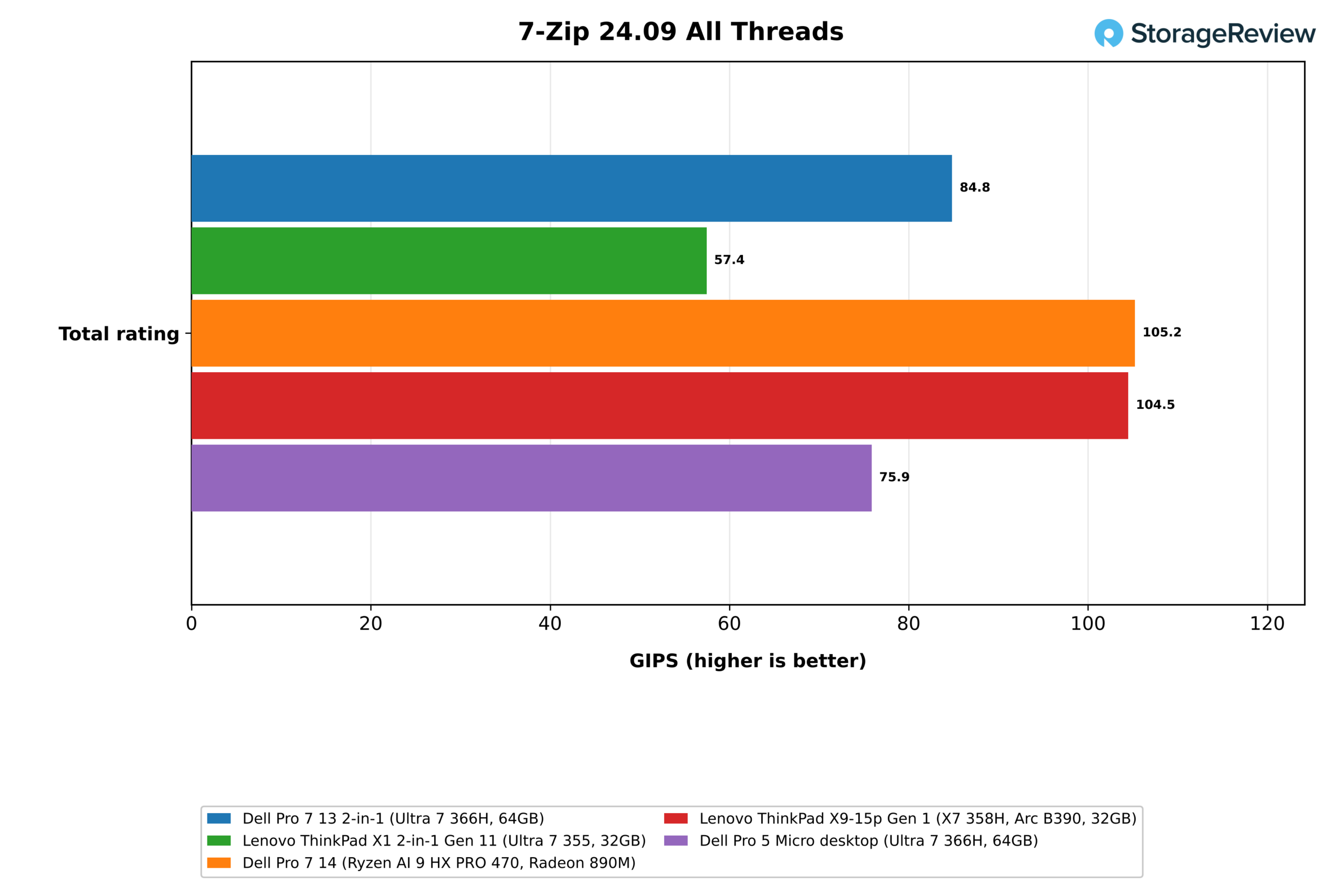
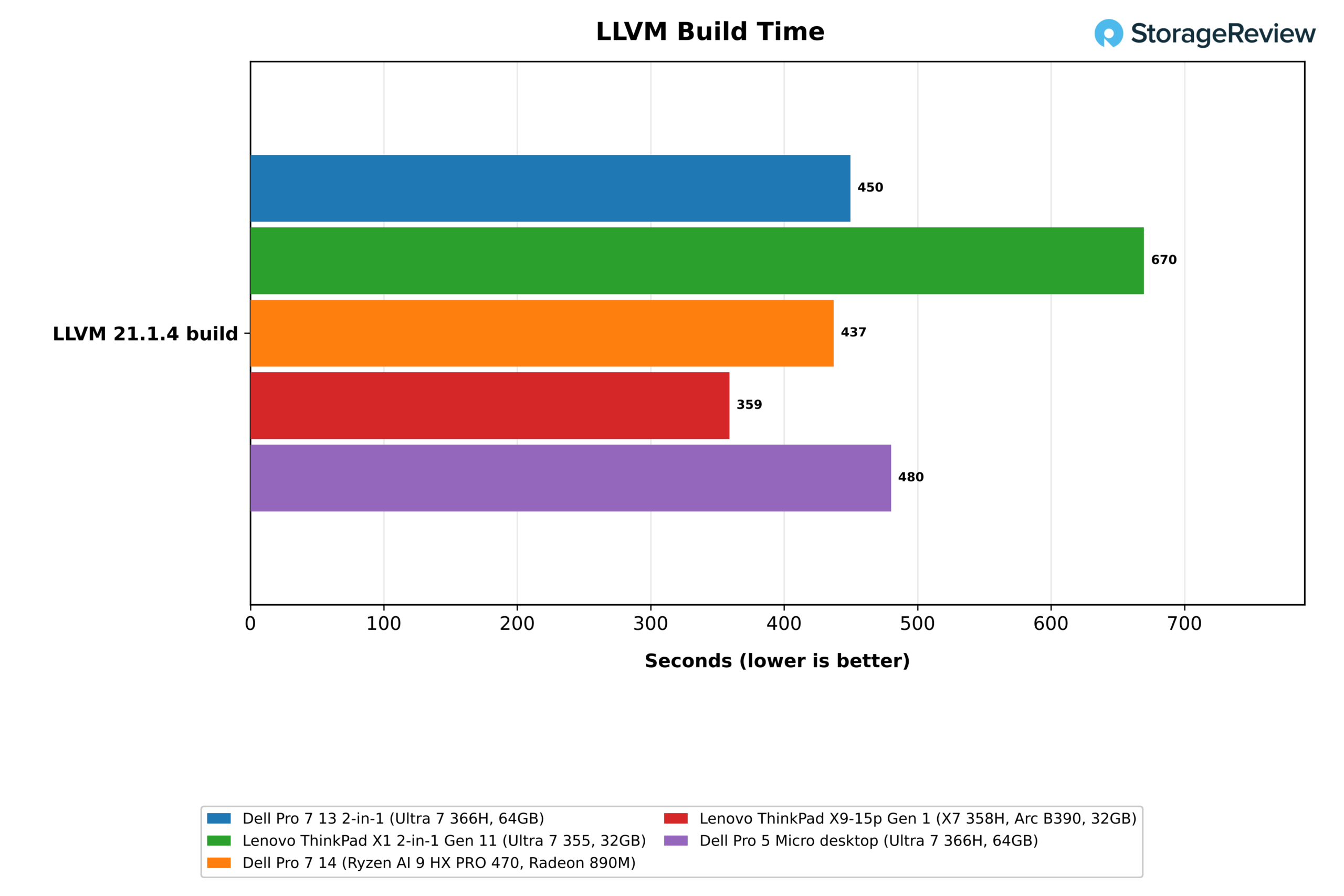
Shorter multi-threaded tests ran clear of that plateau, and the 2-in-1 scored 84.8 GIPS in 7-Zip and 98.2 samples per minute in Blender Monster, 12 percent and 9 percent ahead of the Pro 5 Micro and 48 and 44 percent ahead of the X1 2-in-1. It finished the LLVM build in 450 seconds, 6 percent quicker than the Pro 5 Micro, against 437 seconds on the Dell Pro 7 14 and 359 on the X9-15p.

Stockfish, primesieve, Python, and the Browser
| Test | Dell Pro 7 13 2-in-1 (Ultra 7 366H, 64GB) | Lenovo ThinkPad X1 2-in-1 Gen 11 (Ultra 7 355, 32GB) | Dell Pro 7 14 (Ryzen AI 9 HX PRO 470, Radeon 890M) | Lenovo ThinkPad X9-15p Gen 1 (X7 358H, Arc B390, 32GB) | Dell Pro 5 Micro desktop (Ultra 7 366H, 64GB) |
|---|---|---|---|---|---|
| Stockfish, one thread (Mnps) | 1.73 | 1.65 | 1.96 | 1.74 | 1.70 |
| Stockfish, all threads (Mnps) | 11.17 | 7.73 | 14.74 | 13.84 | 9.87 |
| primesieve to 10^12, all threads (s, lower is better) | 16.52 | 22.20 | 14.95 | 12.04 | 17.41 |
| primesieve to 10^11, one thread (s, lower is better) | 10.44 | 10.60 | 6.67 | 10.15 | 10.62 |
| PyPerformance go (ms, lower is better) | 76.4 | 76.9 | 76.5 | 73.2 | 77.5 |
| PyPerformance nbody (ms, lower is better) | 58.0 | 59.5 | 61.8 | 55.3 | 60.2 |
| Speedometer 3.1 (score) | 41.6 | 38.6 | 36.9 | 40.8 | 42.2 |
The 2-in-1 scored 41.6 in Speedometer 3.1, between the Pro 5 Micro at 42.2 and the X9-15p at 40.8, and it ran PyPerformance go in 76.4ms, level with the other Intel systems. All-thread Stockfish reached 11.17 Mnps against 9.87 on the Pro 5 Micro and 14.74 on the Dell Pro 7 14. Browser, office, and conferencing work, the heart of this machine’s job, runs within 2 percent of the fastest system in the group.
GROMACS, OpenBLAS, and Memory
| Test | Dell Pro 7 13 2-in-1 (Ultra 7 366H, 64GB) | Lenovo ThinkPad X1 2-in-1 Gen 11 (Ultra 7 355, 32GB) | Dell Pro 7 14 (Ryzen AI 9 HX PRO 470, Radeon 890M) | Lenovo ThinkPad X9-15p Gen 1 (X7 358H, Arc B390, 32GB) | Dell Pro 5 Micro desktop (Ultra 7 366H, 64GB) |
|---|---|---|---|---|---|
| GROMACS benchMEM (ns/day) | 17.53 | 15.41 | 21.72 | 21.24 | 16.95 |
| OpenBLAS DGEMM, all cores (GFLOPS) | 347.0 | 272.0 | 390.2 | 469.2 | 299.8 |
| OpenBLAS LU solve N=20000, all cores (GFLOPS) | 342.1 | 262.3 | 377.8 | 444.1 | 326.3 |
| STREAM Triad (MB/s) | 82,386 | 63,620 | 45,108 | 91,270 | 58,967 |
| Memory latency, 4KiB pages (ns, lower is better) | 116.3 | 142.8 | 148.3 | 109.9 | 155.7 |
The LPDDR5X-8533 memory reached 82.4GB/s in STREAM Triad, 40 percent above the Pro 5 Micro’s DDR5-5600 with the same processor and second only to the X9-15p’s LPDDR5X-9600, and memory latency measured 116.3ns. GROMACS benchMEM ran at 17.53 ns/day, 3 percent ahead of the Pro 5 Micro, and OpenBLAS DGEMM reached 347.0 GFLOPS against 469.2 on the X9-15p.

Graphics and GPU Encoding
| SuperTuxKart 1.5 and FFmpeg (higher is better) | Dell Pro 7 13 2-in-1 (Ultra 7 366H, 64GB) | Lenovo ThinkPad X1 2-in-1 Gen 11 (Ultra 7 355, 32GB) | Dell Pro 7 14 (Ryzen AI 9 HX PRO 470, Radeon 890M) | Lenovo ThinkPad X9-15p Gen 1 (X7 358H, Arc B390, 32GB) | Dell Pro 5 Micro desktop (Ultra 7 366H, 64GB) |
|---|---|---|---|---|---|
| SuperTuxKart 1080p, average FPS | 75.6 | 74.9 | 84.9 | 163.9 | 75.3 |
| SuperTuxKart 1080p, typical FPS | 74 | 73 | 84 | 161 | 74 |
| SuperTuxKart 1080p, mostly stable FPS | 63 | 61 | 70 | 132 | 62 |
| SuperTuxKart 1080p, steady FPS | 52 | 50 | 61 | 77 | 51 |
| FFmpeg HEVC Quick Sync (fps) | 128 | 128 | Not run | 128 | 128 |
SuperTuxKart at 1080p averaged 75.6 fps on the 2-in-1 with a 52 fps steady figure, level with the Pro 5 Micro’s 75.3 fps and 51 fps steady on the same graphics and with the X1 2-in-1’s 74.9 fps. The Radeon 890M in the Dell Pro 7 14 averaged 84.9 fps, and the Arc B390 in the X9-15p more than doubled the 2-in-1 at 163.9 fps. HEVC Quick Sync encoding ran at 128 fps, matching every other Intel system here.

Clocks Under Load
| Mean CPU clock (MHz) | Dell Pro 7 13 2-in-1 | Dell Pro 5 Micro desktop |
|---|---|---|
| Cinebench 2026 | 3,305 | 3,324 |
| 7-Zip | 3,109 | 3,251 |
| Blender | 2,841 | 2,806 |
| HandBrake | 2,869 | 2,825 |
| LLVM build | 2,686 | 2,699 |
| GROMACS | 2,311 | 2,408 |
| 30-minute Cinebench loop, steady state | 2,082 | 2,449 |
| LLM serving | 2,617 | 3,615 |
Neither the 2-in-1 nor the Pro 5 Micro exposed a CPU temperature sensor to our suite, so mean clocks tell the thermal story. The two systems run close on short tests, and the 2-in-1 falls behind on long ones: 15 percent lower at the Cinebench loop’s steady state and 28 percent lower during LLM serving, where the graphics and CPU share the heat budget.
Storage Performance
| fio, 25GiB footprint (higher is better) | Dell Pro 7 13 2-in-1 (Ultra 7 366H, 64GB) | Lenovo ThinkPad X1 2-in-1 Gen 11 (Ultra 7 355, 32GB) | Dell Pro 7 14 (Ryzen AI 9 HX PRO 470, Radeon 890M) | Lenovo ThinkPad X9-15p Gen 1 (X7 358H, Arc B390, 32GB) | Dell Pro 5 Micro desktop (Ultra 7 366H, 64GB) |
|---|---|---|---|---|---|
| Sequential read 128K (MB/s) | 13,846 | 6,768 | 6,564 | 7,067 | 7,095 |
| Sequential write 128K (MB/s) | 9,249 | 1,081* | 5,050 | 6,362 | 6,781 |
| Random read 4K, peak (IOPS) | 626,695 | 347,019 | 627,962 | 699,680 | 586,555* |
| Random write 4K, peak (IOPS) | 517,963* | 110,204 | 42,149* | 392,939* | 457,875 |
| Random read 4K, QD32 x 4 jobs (IOPS) | 490,910 | 266,188 | 274,615 | 364,397 | 371,538* |
| Random write 4K, QD32 x 4 jobs (IOPS) | 398,250* | 110,204 | 21,275* | 222,188* | 277,479 |
*Flagged by the suite for run-to-run variance after a rerun.
The 1TB Gen5 SSD read at 13,846MB/s, about twice the drives on Gen4 links in every comparison system, and wrote at 9,249MB/s, and it peaked at 627K random read IOPS and 518K random write IOPS. Random writes at four and 16 jobs were flagged for variance after a rerun, and the eight-job result came back clean at 509K IOPS. For a convertible, this is far more drive performance than office work needs, and it pays off in the fast model loads above.


Conclusion
The Dell Pro 7 13 2-in-1 puts a 16-core Core Ultra 7 366H, 64GB of LPDDR5X-8533, and a Gen5 SSD in a 1.38kg convertible, and on short runs it matches or beats the same processor in Dell’s Pro 5 Micro desktop. It ran 44 to 48 percent ahead of the ThinkPad X1 2-in-1 Gen 11 in Blender and 7-Zip, matched it in SuperTuxKart, and its 47.6GB of GPU-usable memory ran models the 32GB convertibles cannot load. Dell also made the USB-C ports replaceable with a screwdriver, a practical touch on a system that charges through them.
Sustained work is the limit: across a 30-minute Cinebench loop, the 2-in-1 held about 2,900 points, 21 percent under its burst score and 13 percent under the desktop with the same processor. Bursty office, browser, and conferencing work stays at full speed, and long renders, builds, and local AI sessions run slower than the spec sheet suggests. Prompt processing on the integrated graphics also takes 14 to 22 seconds per request on small models.
At $5,501 direct from Dell.com, this configuration costs nearly twice the $2,884.99 that reseller CDW charges for the X1 2-in-1 we tested, and most of the gap is the 64GB memory option and the Gen5 drive. Buyers who need a pen-capable 13-inch convertible for executives and field staff get 40 percent more multi-core performance than the X1 2-in-1 in short bursts, and buyers planning sustained local AI or rendering work will get more from the Dell Pro 7 14 or a desktop such as the Pro 5 Micro.