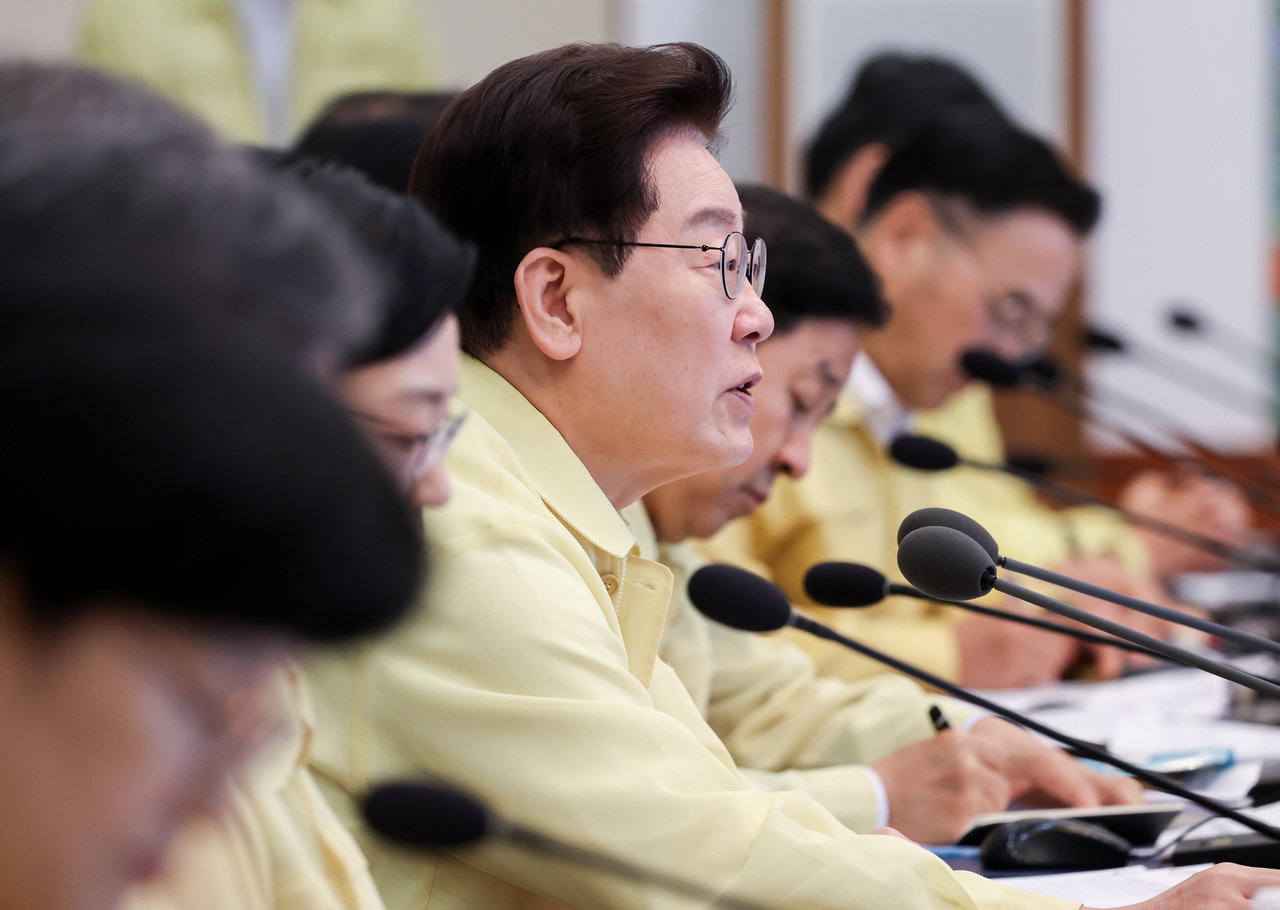
President Lee Jae Myung reaffirmed his commitment to regain wartime operational control from the United States within his term, while calling for faster progress on South Korea’s nuclear-powered submarine program.
Lee made the remarks at a Cabinet meeting on Tuesday at Cheong Wa Dae as South Korea kicked off its four-day annual Ulchi civil defense and emergency preparedness exercise alongside Ulchi Freedom Shield, an annual Korea-US combined military exercise.
“A strong national defense is the most fundamental foundation for protecting the lives of the people and building an irreplaceable Republic of Korea,” Lee said in his opening remarks, referring to South Korea by its official name.
Lee also pointed to South Korea’s already formidable military capabilities, saying its weapons systems and force strength meant that “it would not be an exaggeration to say that we have more than enough capability” to defend the country on its own.
Lee’s emphasis on military readiness came after US President Donald Trump said that he had ordered Defense Secretary Pete Hegseth to “substantially reduce” joint military exercises with South Korea in a Truth Social post on Sunday.
Trump said that the combined exercises sent a “signal that is totally inappropriate and hostile,” while touting his “very good relationship” with North Korean leader Kim Jong-un.
During the meeting, Lee further underscored the need to enhance operational capabilities across all domains and establish a system to develop the personnel needed to further strengthen the country’s defense capabilities.
“To this end, we must move forward, in accordance with the government’s original plan and without disruption, toward regaining wartime operational control within the administration’s term,” Lee said.
Lee stressed that “a strong ROK-US alliance and stronger self-reliant defense capabilities are mutually necessary and sufficient conditions.”
“In other words, the alliance must remain strong to reinforce the foundations of our security, while we must strengthen our own capabilities to increase our value and importance as an ally,” Lee said.
“I also ask that we accelerate the nuclear-powered submarine project, which will symbolize the future of a more constructive and stronger ROK-US alliance.”
The project has advanced since US President Donald Trump approved South Korea’s plan to build nuclear-powered attack submarines following his summit with Lee in Gyeongju last October.
In a joint fact sheet released the following month, the US said it would “work closely with the ROK to advance requirements for this shipbuilding project, including avenues to source fuel.”
South Korea in May unveiled a road map for launching its first domestically built nuclear-powered submarine in the mid-2030s, while pledging to uphold its nuclear nonproliferation commitments.
Seoul would still need Washington’s consent to enrich uranium for a nuclear-powered submarine under the bilateral 123 Agreement, as uranium enrichment requires prior US approval and US-origin nuclear material and technology are limited to peaceful uses.
Speaking at the Cabinet meeting, Lee also urged the military to push ahead with plans to merge South Korea’s Army, Navy and Air Force academies into the tentatively named National Military Academy.
“Furthermore, to prepare for future warfare in which distinctions between battlefields have become meaningless, we must also foster military leaders equipped with integrated operational capabilities,” Lee said. “Preparations for the establishment of the National Military Academy must also proceed without wavering.”
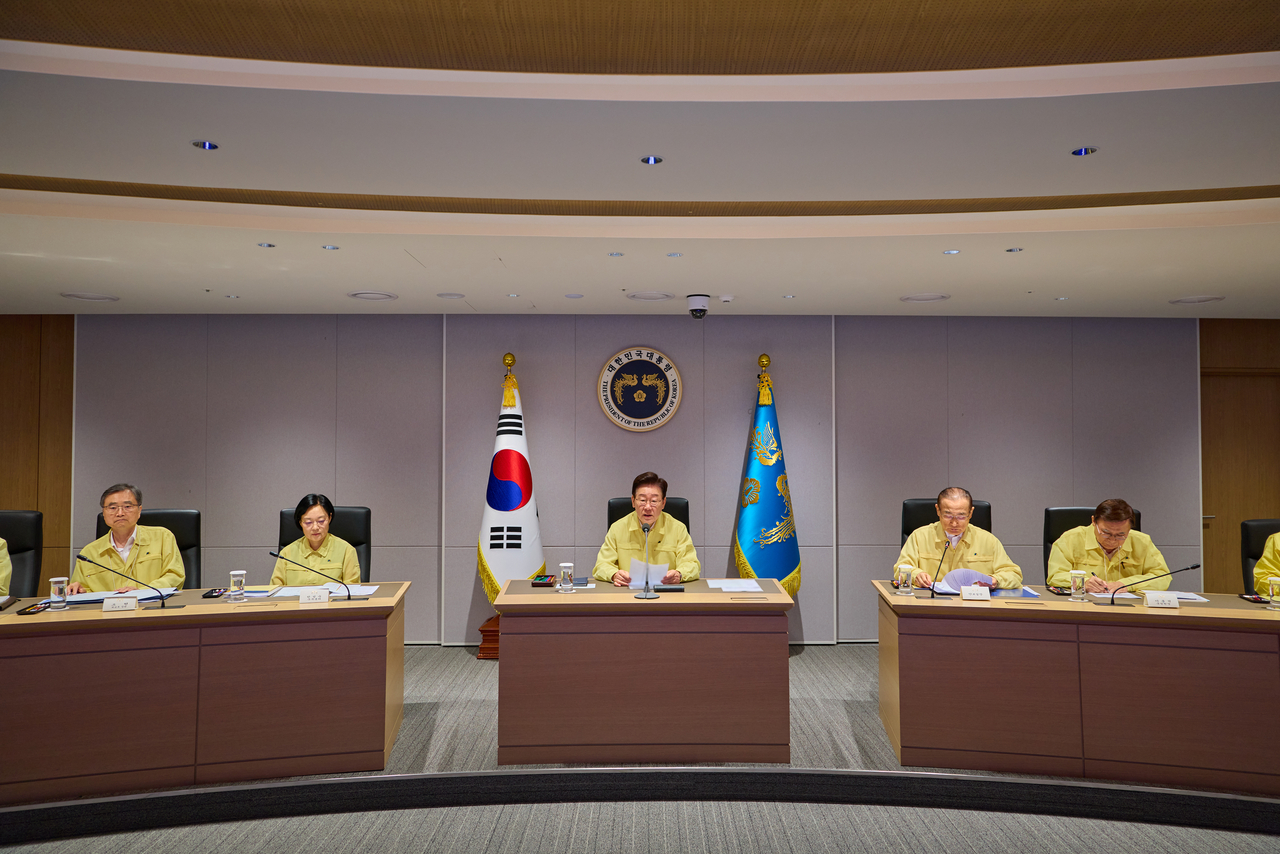
Before the Cabinet meeting, Lee presided over a closed-door meeting of the Ulchi National Security Council at the National Crisis Management Center within the Cheong Wa Dae compound.
The meeting was aimed at reviewing “the nation’s capacity for a whole-of-nation wartime response, as well as each agency’s procedures and measures for transitioning to a wartime footing,” senior presidential spokesperson Kang Yu-jung said in a statement.
Kang said Lee instructed officials “not to simply repeat the Ulchi exercise as it has been conducted in the past.”
Lee stated the exercise should “reflect the changing nature of modern warfare and turn it into a practical, realistic preparedness exercise for a whole-of-nation war effort, ensuring that the country is ready to protect its people under any circumstances.”
During the NSC meeting, Lee underlined that “while creating a peace in which there is no need to fight is of paramount importance, the country must also prepare for the worst.”
Lee called for the Ulchi exercise to “serve as a practical drill for protecting the public and safeguarding national security in an emergency.”
Lee also reiterated that the Ulchi exercise is defensive in nature and aimed at protecting the lives and safety of the Korean people, stressing that it “is not intended to attack North Korea or heighten tensions on the Korean Peninsula,” according to Kang.
dagyumji@heraldcorp.com