 Jung Min-kyung
Since 2017, I have covered South Korea’s political and economic landscape as a reporter, with a focus on foreign affairs, inter-Korean relations and security.
As a foreign affairs reporter, I closely follow developments from the Ministry of Unification, the Foreign Ministry and the Defense Ministry, tracking shifts in diplomacy, military policy and North Korea’s evolving posture. My work focuses on the intersection of geopolitics, security and policy decisions shaping the Korean Peninsula.
Earlier in my career, I also reported on South Korea’s financial sector, covering banking, markets and regulatory developments—experience that continues to inform my understanding of how economic policy intersects with national strategy.

US President Donald Trump’s order to “substantially” reduce joint South Korea-US military exercises has raised questions over whether the allies can again scale back major drills as they did during his first term, while triggering sharp criticism from South Korea’s main opposition party over the Lee Jae Myung administration’s handling of the alliance.
Trump said Sunday that he had instructed the Pentagon to reduce the exercises, calling them costly and saying they send a “totally inappropriate and hostile” signal to North Korea.
“Based on my very good relationship with Kim Jong Un, of North Korea, I am not happy with the fact that the United States has, long ago, agreed to participate in Joint Military Exercises with South Korea,” Trump wrote on Truth Social.
He added that the exercises are “not only costly” but send an inappropriate and hostile signal to a country that he described as having been “unthreatening and respectful” while he has been president.
“Based on the fact that it is too late to cancel, I have instructed Secretary of War, Pete Hegseth, to substantially reduce the Joint Military Exercises!” Trump wrote.
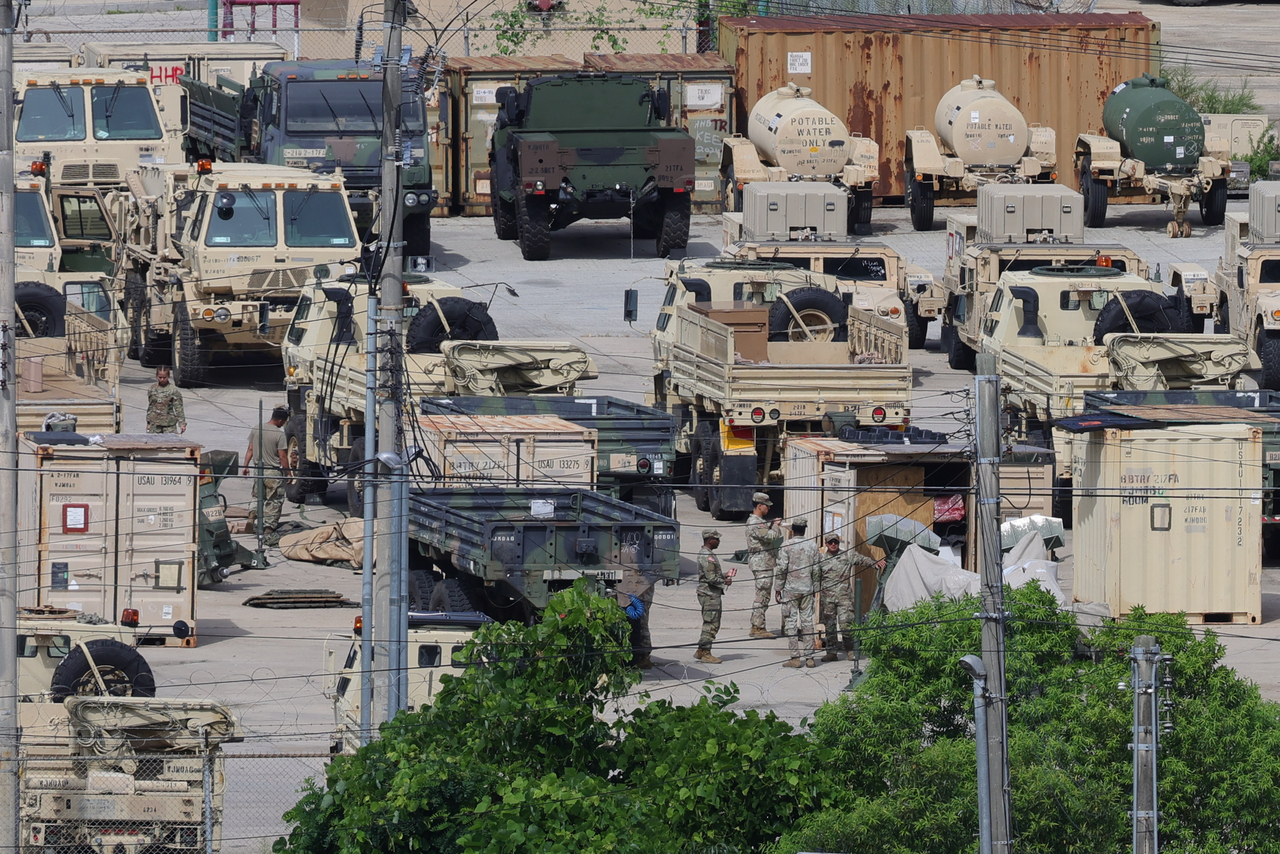
The remarks came just hours before South Korea and the US began their annual Ulchi Freedom Shield exercise Monday, immediately raising questions over whether the exercise can be adjusted after already getting underway.
South Korean military authorities said UFS was proceeding as scheduled, and no specific request from Washington to alter the scale of the exercise was known to have been delivered as of Monday.
UFS is a theater-level combined exercise conducted annually to strengthen the allies’ ability to defend the Korean Peninsula. South Korean and US military authorities had announced plans to conduct 14 battalion-level or larger combined field training exercises during this year’s UFS.
While the number of field drills during UFS is slightly lower than last year, South Korean military authorities had not detected any move by the US to reduce the exercise during the planning process.
Trump’s announcement, however, has revived memories of his first term, when his criticism of joint exercises as expensive and provocative ultimately led to the suspension and restructuring of some of the allies’ largest drills.
Following his first summit with Kim in Singapore in June 2018, Trump abruptly announced that the US would halt joint military exercises with South Korea, saying the suspension would remain in place “unless and until” negotiations failed to progress as expected and would save Washington “a tremendous amount of money.”
Ulchi Freedom Guardian, a theater-level exercise scheduled for August 2018, was suspended for the first time in 28 years.
In 2019, the allies also ended the Key Resolve and Foal Eagle exercises as part of efforts to support diplomacy with North Korea, replacing them with scaled-down command post exercises and smaller field training drills.
The allies subsequently relied largely on computer-simulated command post exercises in the first and second halves of each year before restoring large-scale field training under the Yoon Suk Yeol administration in 2022.
They currently conduct Freedom Shield in the first half of the year and Ulchi Freedom Shield in the second half. While command post exercises form the core of both, they are accompanied by field training exercises based on their respective scenarios.
South Korean military authorities had also planned to increase the number of battalion-level or larger combined field training exercises from about 140 last year to around 160 this year, raising questions over whether that plan will be carried out unchanged following Trump’s order.
Some experts see the move as a possible gesture toward Pyongyang rather than simply an attempt to reduce costs.
Trump has repeatedly signaled that he remains interested in restoring direct diplomacy with Kim, whom he met three times during his first term — in Singapore in June 2018, Hanoi in February 2019 and at the inter-Korean border village of Panmunjom in June 2019.
During the weekend, Trump posted a photo of himself with Kim at Panmunjom and said the two “get along great.” In June, he also posted a photo from their Singapore summit.
The White House has repeatedly said Trump remains open to dialogue with North Korea without preconditions.
Yu Ji-hoon, a research fellow at the Korea Institute for Defense Analyses in Seoul, said that Trump may be seeking to use the joint exercises as leverage to improve the environment for renewed talks.
“President Trump’s remarks on scaling back the combined exercises appear to reflect an intention to use them as a tool to create an environment conducive to negotiations, with the resumption of dialogue with North Korea in mind,” Yu said.
“However, if the combined exercises are repeatedly scaled back, there is a risk that the proficiency of the allies’ combined defense posture and the consistency of their deterrence signaling toward North Korea could weaken.”
If Washington’s intention is to create conditions for renewed US-North Korea dialogue, the Lee administration could potentially respond positively.
Lee said at a press conference with foreign media in December last year that Seoul should be prepared to consider adjusting South Korea-US joint exercises if doing so were necessary to create conditions for Washington-Pyongyang talks.
Lee has also said his administration is prepared to play the role of a “pacemaker” in supporting US efforts to advance peace on the Korean Peninsula.
But any substantial reduction in the exercises could prompt concerns over deterrence against North Korea, which has continued to advance its nuclear and ballistic missile capabilities, observers say.
It could also complicate the Lee administration’s push to complete the transition of wartime operational control, or OPCON, within his term.
Combined exercises are central to assessing whether conditions for the OPCON transition have been met, including South Korea’s ability to lead the allies’ combined defense and respond to North Korea’s nuclear and missile threats.
During this year’s UFS, South Korea and the US are conducting joint assessments of capabilities and systems required for the transition.
The Defense Ministry aims to complete a Full Operational Capability assessment of the future Combined Forces Command this year and, at the annual Security Consultative Meeting this fall, discuss setting a target year — known as “Year X” — for the OPCON transition.
Trump’s announcement also quickly became a source of domestic political controversy.
The main opposition People Power Party on Monday blamed the Lee administration, saying that Trump’s move reflected what it called the government’s weakened security policy and failure to maintain trust with Washington.
“The South Korea-US joint exercise that begins today is facing a security debacle, with President Trump’s unilateral order to substantially scale it back,” PPP chief spokesperson Park Sung-hoon said in a statement.
Park said the possibility that an exercise designed to test the allies’ response to North Korean threats could be significantly weakened was “entirely a consequence of the Lee Jae Myung administration’s own making.”
He also criticized the government’s policy toward North Korea, arguing that it had contributed to what he called Washington’s distorted perception of the Kim regime as “unthreatening and respectful.”
Park pointed to Trump’s claim that he had recently asked Lee whether South Korea would join efforts to denuclearize Iran and was told, “No thanks,” arguing that the episode had damaged trust between the allies.
PPP lawmaker Na Kyung-won said via Facebook that Trump was “shaking the combined defense posture, a key pillar of the South Korea-US alliance,” by emphasizing his relationship with Kim and focusing on the cost of the exercises.
“The more than 70-year-old South Korea-US alliance is facing an unprecedented crisis,” Na said in a Facebook post, adding that an alliance “forged in blood” had been reduced to a matter of “cost and transactions.”
PPP Rep. Kim Gunn, a member of the National Assembly’s Foreign Affairs and Unification Committee, questioned whether the presidential National Security Office, Foreign Ministry and South Korean Embassy in Washington had sufficiently monitored developments in Washington and coordinated with the US.
“The government must mobilize every available means to repair the cracks in South Korea-U.S. relations,” Kim said on Facebook.
In Washington, Sen. Andy Kim, a Korean American Democrat from New Jersey, also expressed concern over the unilateral nature of Trump’s announcement.
“Decisions about joint exercises need to be made jointly — and not announced unilaterally by social media,” Kim said in a statement, stressing that the South Korea-US alliance remains critical to US security and prosperity.
mkjung@heraldcorp.com
- Trump order to scale back S. Korea-US drills raises alliance concerns
- N. Korea considering expanding troop deployment to Russia: report
- ASEAN chief urges deeper Korea ties on energy, digital transition
-
Southeastern Korea hit by nearly 800 mm of rain, floods and landslides
x
-
Why Samsung’s Fold8 won by breaking the foldable formula
x
-
Changwon asks public how to save its $24 million ‘ugly’ landmark
x