PPP support falls 4.5 points as internal feuds blunt gains from attacks on government
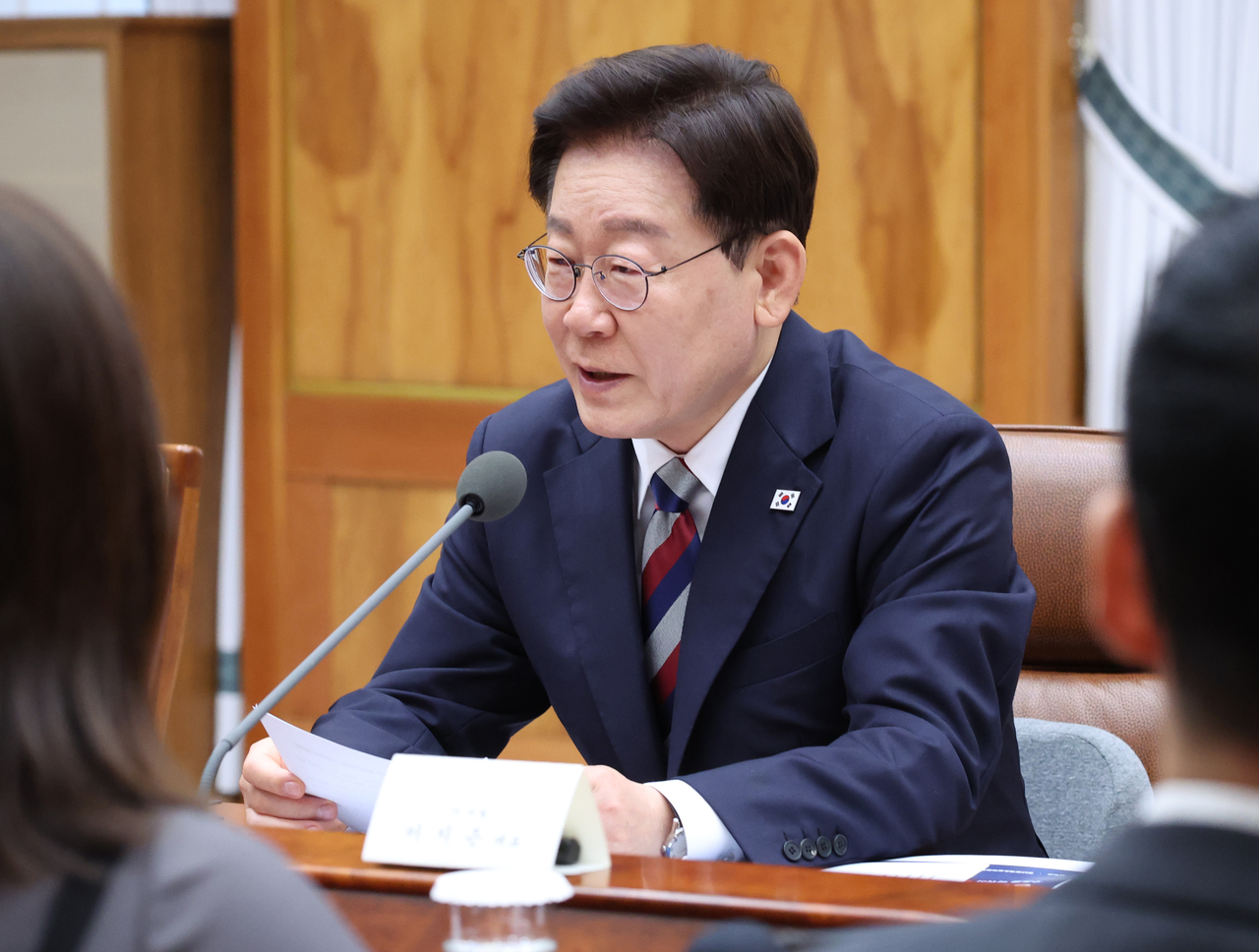
President Lee Jae Myung’s approval rating fell for a fifth consecutive week to a new low of 43 percent, with a local pollster attributing the decline largely to confusion over the administration’s property tax overhaul.
The poll results also showed that the main opposition People Power Party failed to benefit from Lee’s declining approval.
The poll released Monday by Realmeter showed that 43 percent of respondents approved of Lee’s job performance, down 0.3 percentage point from the previous week. His disapproval rating rose 1.1 percentage points to 54.1 percent.
The 11.1-point gap between positive and negative assessments was well outside the poll’s margin of error of plus or minus 2 percentage points.
The survey was conducted from Aug. 10-14 among 2,511 voters aged 18 and older.
Lee’s approval rating has fallen from 48.9 percent in the second week of July to 48.4 percent, 46.3 percent, 45.9 percent, 43.3 percent and 43 percent in the second week of August.
Realmeter largely attributed the continued decline to public confusion surrounding proposed changes to property taxes announced by the Lee administration on Aug. 3.
A growing backlash over a controversial suggestion on Aug. 7 by Rep. Hwang Hee of the ruling Democratic Party to turn decommissioned buses into housing for young people further weighed on Lee’s approval, according to the pollster.
“Confusion over proposed changes to real estate taxes, coupled with growing discontent among young people over housing sparked by the ‘discarded-bus youth housing’ remarks, appears to have compounded an erosion of confidence in government policy and led to a decline in positive assessments,” Realmeter said.
The decline was particularly pronounced among older voters. Approval fell 6.1 percentage points among voters in their 60s, 2.9 percentage points among those in their 30s and 1.5 percentage points among those in their 40s.
Regionally, Lee’s support dropped 2.6 percentage points in Incheon and Gyeonggi Province, 2.4 percentage points in Busan, Ulsan and South Gyeongsang Province, and 1.9 percentage points in Daejeon, Sejong and the Chungcheong provinces.
Opposition fails to gain ground
The erosion in Lee’s approval, however, did not translate into gains for the conservative opposition party.
A separate Realmeter survey conducted Aug. 13-14 among 1,004 voters found support for the ruling Democratic Party at 47.9 percent, up 3.3 percentage points from the previous survey.
Support for the main opposition People Power Party fell 4.5 percentage points to 33.1 percent.
The 14.8-point gap between the two parties remained outside the survey’s margin of error for a third consecutive week.
Realmeter said the Democratic Party benefited from a bounce ahead of Monday’s national convention, where it is set to announce the final tally after regional primaries that began July 28.
“With the party convention approaching, a convention bounce has begun to take hold, while stronger consolidation among party members and supporters appears to have driven the rise,” Realmeter said.
The People Power Party, by contrast, failed to capitalize on its criticism of the government’s real estate and tax policies as intensifying internal feuds weighed on its support.
“Despite attacking the government over confusion surrounding its real estate and tax reform plans, the party failed to reap any clear political benefit,” Realmeter said.
“Instead, intensifying internal conflict appears to have weakened the party’s support, with support declining both among conservative voters and in its regional strongholds, contributing to the overall drop.”
The Democratic Party gained 15.8 percentage points in Daegu and North Gyeongsang Province and 12.1 percentage points in Daejeon, Sejong and the Chungcheong region.
But its support fell 10.8 percentage points in Busan, Ulsan and South Gyeongsang Province and 5.9 percentage points among self-described moderates.
The People Power Party lost 20.3 percentage points in Daegu and North Gyeongsang Province and 6.1 percentage points in Incheon and Gyeonggi Province, while gaining 4.5 percentage points among self-employed respondents.
By age, Democratic Party support rose 11.5 percentage points among voters aged 70 and older and 9.8 percentage points among those in their 20s, while declining 2.5 percentage points among voters in their 60s.
Support for the People Power Party rose 7.9 percentage points among voters in their 20s, 7.7 percentage points among those aged 70 and older and 5.8 percentage points among those in their 40s.
Both surveys were conducted through automated response calls using randomly generated wireless phone numbers. The presidential approval survey had a response rate of 4 percent and a margin of error of plus or minus 2 percentage points at the 95 percent confidence level. The party support survey had a response rate of 3.5 percent and a margin of error of plus or minus 3.1 percentage points.
dagyumji@heraldcorp.com