- NATURE BRIEFING
More land for conservation is positive, but doesn’t necessarily protect biodiversity, say researchers. Plus, say goodbye to the leap second and how the Inca empire lasted longer than we thought.
Hello Nature readers, would you like to get this Briefing in your inbox free every day? Sign up here.

Metrologists retire the leap second immediately, instead of by 2035. Credit: Alejandro Martinez Velez/Europa Press via Getty
Leap second goes into early retirement
On 15 October, member states of the General Conference on Weights and Measures (CGPM) voted to scrap the ‘leap second’ — periodic adjustments to the world’s clocks to align time given by the sun’s position in the sky, with the more stable ticking of atomic clocks, known as Universal Coordinated Time. The CGPM had previously voted to ditch leap seconds by 2035, but yesterday’s decision had immediate effect. The leap second’s replacement — the ‘leap hour’ — probably won’t be needed for thousands of years, effectively pushing the issue onto future generations.
Nature | 4 min read
AI writing creeps into PhD dissertations
Roughly 30% of science, technology, engineering and maths PhD dissertations from US universities this year contained text generated by artificial intelligence, according to an analysis of more than 226,000 dissertations. The study also found that PhD graduates who used AI to help write their dissertations were more likely to pursue a career in industry, and less likely to enter academia. This might be because students feel they won’t be judged for having used AI in jobs outside academia, says economist and study co-author Daniel Gross.
Nature | 5 min read
Reference: National Bureau of Economic Research working paper (not peer reviewed)
Woody ‘blankets’ deployed on permafrost
A start-up firm called PermaC is developing a way to prevent greenhouse-gas emissions from permafrost by stabilizing the soil with an insulating ‘blanket’ of woody materials. If the method works, it could be the first tool to directly forestall greenhouse-gas emissions that are escaping from permafrost — estimated to be equivalent to the annual emissions of Japan. But there are big challenges to rolling out such an approach on a meaningful scale.
Nature | 7 min read
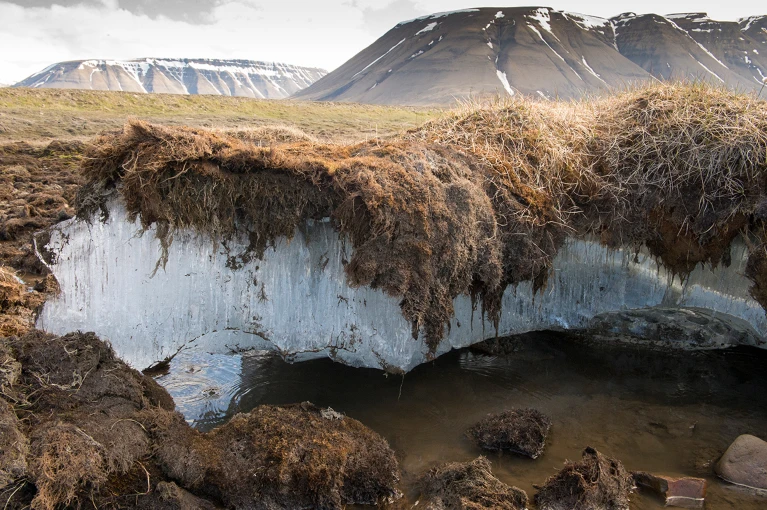
As permafrost thaws in the Arctic, a company wants to use blankets to prevent erosion of the landscape.Credit: Jeff Vanuga/Nature Photo Library/Science Photo Library
Features & opinion
Inca empire lasted longer than we thought
Radiocarbon dating is transforming our understanding of the lifespan of the Inca empire — which was thought to be just 94 years, on the basis of a Spanish colonial chronicle. Radiocarbon dating has uncertainties, but it’s getting more accurate thanks to advanced statistical models, comparisons with tree-ring records and a better understanding of how carbon-14 isotopes levels vary by location. The new data suggest the Inca empire started earlier and lasted longer, and change archaeologists’ vision of how the Inca made their conquests.
Science | 19 min read
‘Trees are witnesses’
Researchers are using dendrochronology — tree-ring dating — to delve into the history of forest management by Indigenous people in what is now North America. Critics disagree that ancient wood contains signals of a concerted regime of anthropogenic fire — the human use of fire as a tool. But the evidence backs up traditional knowledge that is “encapsulated in our language, stories, and ceremonial protocols”, says Maskoke scholar Marcus Briggs-Cloud. Forest ecologist Michael Stambaugh agrees. “Trees are witnesses,” he says.
The New Yorker | 20 min read (intermittent paywall)
Futures: science fiction from Nature
An artificial-intelligence entity embraces the beauty of the natural order in Becoming real and an android realizes there’s more to life than her programming in The pianist who never played.
Nature | 6 min read & Nature | 6 min read
Podcast: we’re close to 30by30 target
According to official statistics, conservation areas cover 18.5% of land on Earth — a way off governments’ committed target of 30% by 2030. New research suggests that this figure is probably an underestimate, and that conservation areas actually cover around 27% of land. But simply having more land isn’t enough to preserve biodiversity, ecologist Bob Smith tells the Nature Podcast. “By fixating on meeting the area target, often governments don’t put any more money in,” he says. Instead, available funding “gets spread even more thinly”.
Nature Podcast | 21 min listen
Subscribe to the Nature Podcast on Apple Podcasts, Spotify or YouTube Music, or use the RSS feed.
Quote of the day
doi: https://doi.org/10.1038/d41586-026-03348-w
Today, Leif Penguinson is looking up at one of the highest waterfalls in Sweden: Njupeskär in Fulufjällets National Park. Can you find the penguin?
The answer will be in Monday’s e-mail, all thanks to Briefing photo editor and penguin wrangler Tom Houghton.
This newsletter is always evolving — tell us what you think! Please send your feedback to briefing@nature.com.
Thanks for reading,
Flora Graham, chief editor, Nature Briefing
With contributions by Jacob Smith
• Nature Briefing: Careers — insights, advice and award-winning journalism to help you optimize your working life
• Nature Briefing: Microbiology — the most abundant living entities on our planet — microorganisms — and the role they play in health, the environment and food systems
• Nature Briefing: Anthropocene — climate change, biodiversity, sustainability and geoengineering
• Nature Briefing: AI & Robotics — 100% written by humans, of course
• Nature Briefing: Cancer — a weekly newsletter written with cancer researchers in mind
• Nature Briefing: Translational Research — covers biotechnology, drug discovery and pharma