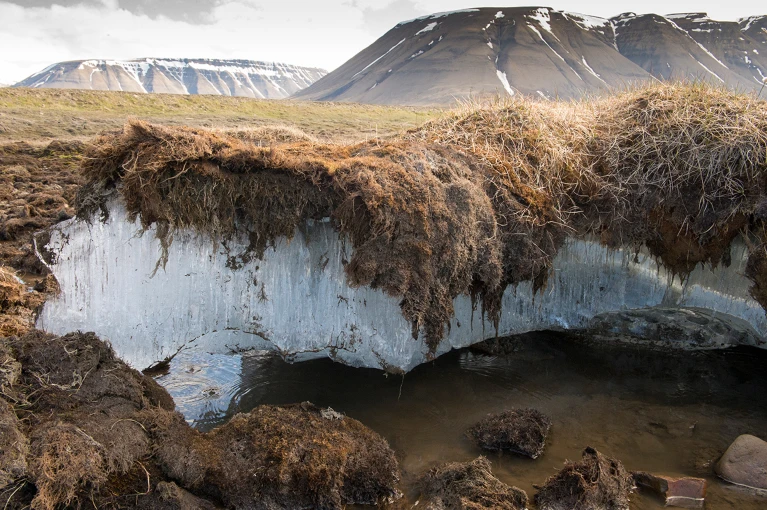
As permafrost thaws in the Arctic, a company wants to use blankets to prevent erosion of the landscape.Credit: Jeff Vanuga/Nature Photo Library/Science Photo Library
A Canadian start-up firm is developing a way to prevent greenhouse-gas emissions from permafrost by stabilizing the soil with an insulating ‘blanket’ of woody materials. If the method works, it could be the first tool to directly forestall green-house gas emissions that are escaping from permafrost as the Arctic heats.
“Our goal is to make sure the carbon in the soil remains buried,” says Cansu Culha, co-founder of PermaC and a natural-hazards researcher at the University of British Columbia in Vancouver, Canada.
Earth’s frozen environments are thawing as temperatures rise in response to human emissions. The only reliable way to slow that melting on a global scale is to slash emissions from the burning of fossil fuels. But some researchers are exploring methods to prevent the thaw directly, ranging from placing reflective mats on glaciers to pumping water onto sea ice to thicken it.
Researchers say that PermaC’s approach is the first they know of to focus on preventing permafrost thaw and its associated emissions, which are estimated to be equivalent to those of Japan.
The company just completed the first test of its insulating blankets in Canada’s Northwest Territories at an area of rapidly eroding permafrost known as a retrogressive thaw slump. These slumps occur when a hill of permafrost thaws and collapses, enabling erosion to take big bites out of the landscape. This exposes deeper layers of soil to warming, forming hotspots of CO2 and methane emissions. One estimate suggests that these areas of rapid erosion could amplify permafrost emissions by as much as 40% compared to models that only account for gradual thaw.
The company’s approach is to stabilize the edge of the slumps with a layer of wood shavings, soil and native seeds, and a burlap-like mat of coconut husks. Culha says she got the idea after hearing about Indigenous communities in Alaska that prevent permafrost degradation by planting trees along the edges of slumps. Similar erosion-control blankets are used in temperate areas, but they haven’t been used to insulate or stabilize permafrost until now, she says.
PermaC has yet to release results from this year'stest. But the blanket seems to have halted erosion: over the Arctic summer, the edge of the slump without the blanket retreated by 5 metres, whereas the blanketed area saw no measurable retreat, Culha says.
“That’s very promising,” says Christina Schaedel, a permafrost scientist at the Woodwell Climate Research Center in Falmouth, Massachusetts, who has been advising the company. However, the result is from only one slump over one summer, she adds.
Green blanket
One challenge is calculating how much CO2 the blankets prevent from being emitted. Measuring the CO2 emissions from slumps is not straightforward and remains an active research question, says Mark Lara, a biologist who studies permafrost landscapes at the University of Illinois at Urbana-Champaign. “There definitely are slumps that are spewing out carbon,” he says. But there are “lots of minutiae that could dramatically impact the results”, he adds. For instance, the emissions from any given slump depend on its geometry, the amount of carbon in the soil and how much of that carbon ends up as CO2 or methane after erosion.
So far, Culha has only rough estimates for the emissions that the blankets might prevent. Extrapolating from research on erosion rates and soil carbon in the Arctic, she thinks that about 2,200 tonnes of CO2 a year might be prevented from being emitted at the average carbon-rich slump. If those calculations are accurate and the blankets can be installed at 20,000 slumps across Canada and Alaska — the company’s ambitious goal over the next decade — she estimates that they might prevent about 40 million tonnes of CO2 emissions a year, roughly equivalent to the annual emissions of Hungary.
Culha says the company is developing a detailed methodology that a third party could use to verify prevented emissions, which would be necessary for the company to sell carbon credits for emissions the blankets prevent. People could purchase those credits to offset emissions elsewhere. The firm aims to issue credits as soon as next year, and has so far raised Can$1.4 million (US$1 million) from investors, says Culha.