Choi He-suk
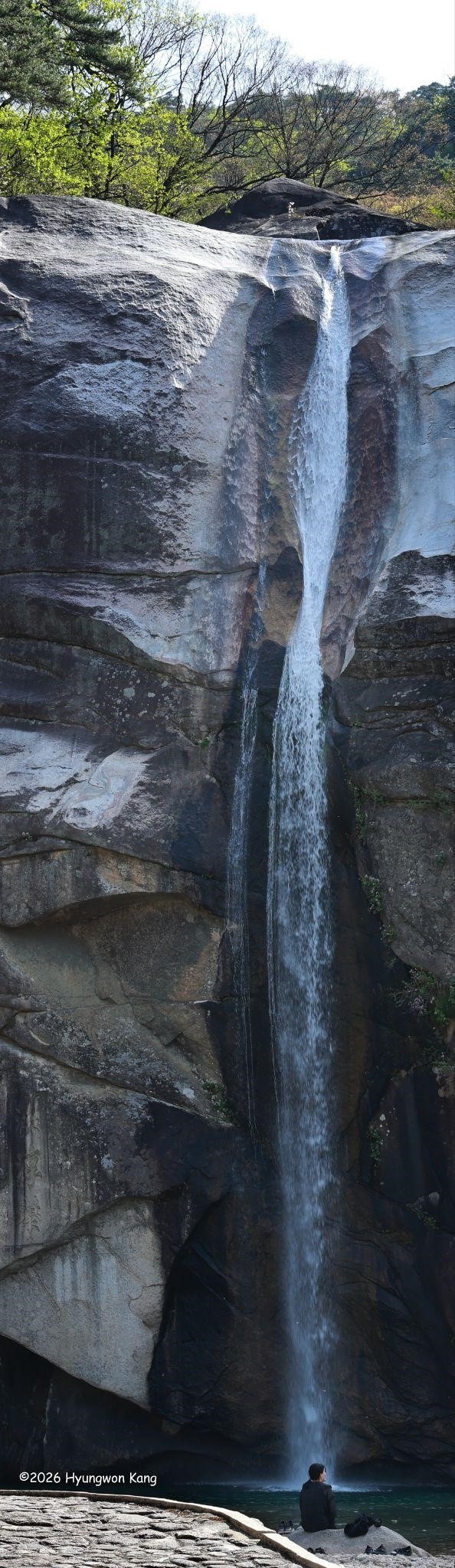
When I visited Bangnyeon Falls near Kaesong during April’s spring drought, the diminished flow revealed names carved into cliffs normally obscured by falling water. Among them was Hong Sun-hyeong, a former minister of justice who served as governor of Kaesong in 1892.
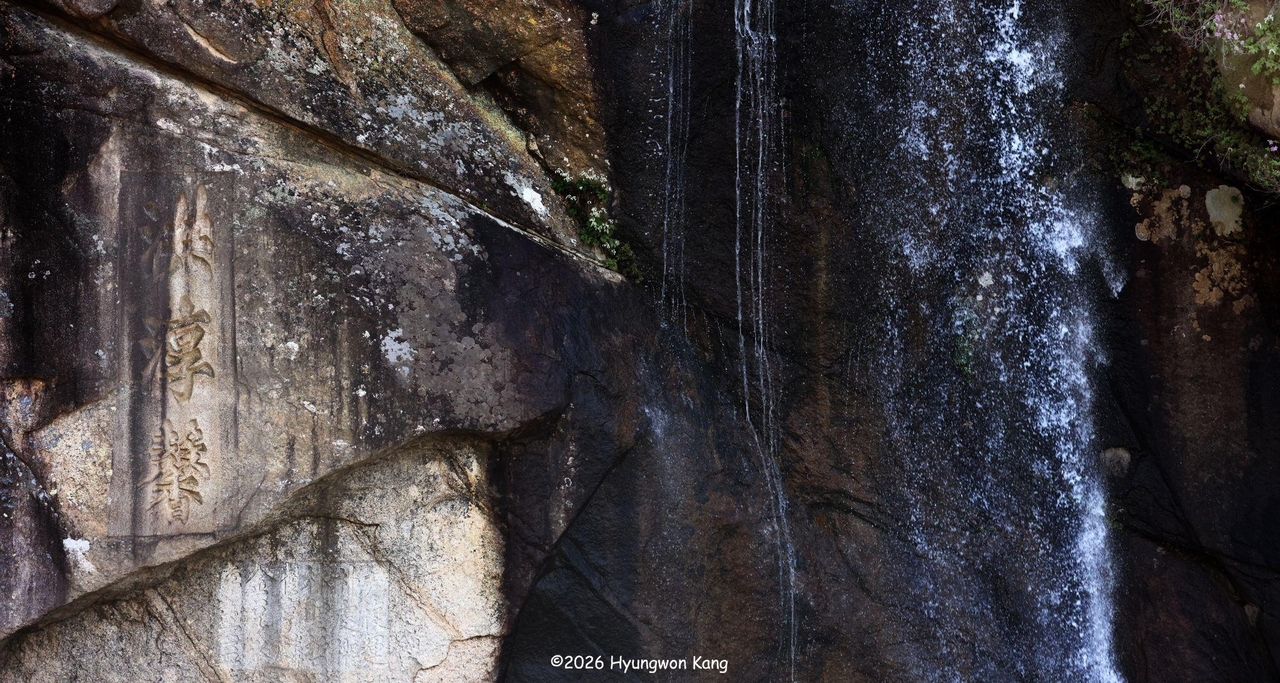
His name remains prominently carved in stone. But the city’s most enduring names suggest other ways to outlive one’s time.
Kaesong, historically known as Songdo, celebrates three treasures as Songdosamjeol: Bangnyeon Falls, one of Korea’s three best-known waterfalls; Hwang Jin-i, one of the most gifted female artists in Korean history; and Seo Gyeong-deok, also known as Hwadam, one of the Joseon era's most significant thinkers and a true seonbi who lived the life of a sage.
True freedom is the ability to decide one’s own destiny. Hwang pursued that freedom within a society that assigned women their futures by birth and status.
Known as Myeongwol, or “bright moon,” Hwang was a poet, musician and performer whose intelligence matched her beauty. Her profession as a gisaeng, or female entertainer, combined training in poetry, music and dance with low social standing. Talent could win elite admiration without opening the doors of privilege.
Her biography survives largely through later anecdotes. One tradition describes her as a nobleman’s daughter by a concubine of lower status. Becoming a gisaeng offered an outlet for gifts that conventional domestic life might have confined.
To me, her choices embody the spirit of women’s liberation centuries before the modern movement.
The story of her partnership with Yi Sa-jong, a celebrated singer and royal military officer, is especially striking. They agreed to six years together: Hwang would support their households for three years, and Yi for the next three. When the term ended, they parted.
A 16th-century power couple, they negotiated their obligations, with Hwang helping determine the terms.
Other stories celebrate her sex appeal. She reportedly induced Ven. Jijok, a Buddhist monk famed for a decade of ascetic practice, to break his vows. Yet she could not seduce Hwadam. Instead, she sought him as a teacher.
The woman who captivated others was herself captivated by a mind.
The Kaesong seonbi Hwadam (1489–1546) explored a universe in continual transformation. At its foundation was gi, an enduring substance or vital force that gathers into forms and disperses when those forms pass away. Things change; gi itself does not disappear.
For a modern reader, his thinking offers a striking philosophical parallel to the law of conservation of energy in modern physics. In 16th-century Korea, Hwadam articulated this principle of persistence through transformation over a century before conservation of energy was established as a scientific law.
His essays and poems were collected in "Hwadamjip." His reputation also crossed borders: The work was listed in the supplementary catalogue associated with the Qing imperial Siku Quanshu project. A Korean scholar working away from the center of political power had attracted the attention of scholars abroad.
In my book, "Seonbi Country Korea, Seeking Sagehood," I explore the Korean ideal of the seonbi: a learned person whose pursuit of knowledge is inseparable from the cultivation of character and the pursuit of sagehood. Hwadam embodied that ideal by making study and teaching his life’s work.
Government service meant having skin in the game. Politics was a blood sport: Jo Gwangjo, who tried to recruit him in 1519, was later exiled and executed by poison during that year’s purge.
Remaining outside government spared Hwadam that political fate. In 1575, he nevertheless received the posthumous title of right state councilor. At Kaesong’s UNESCO-listed Sungyang Sowon, his spirit tablet records that honor in the Korean alphabet.
At the waterfall, guide Park Geum-hwa told me that carving one character once cost as much as an ox. Wealthy patrons sought permanence on the cliffs, while stonemasons bore the danger.
Hwang’s connection to the falls takes a more imaginative form. Local lore attributes calligraphy on the Bangnyeon Dragon Rock to her. She is said to have used the ends of her hair dipped in ink to write Li Bai’s lines:
The torrent plunges straight down three thousand feet,
as though the Milky Way were falling from the highest heaven.
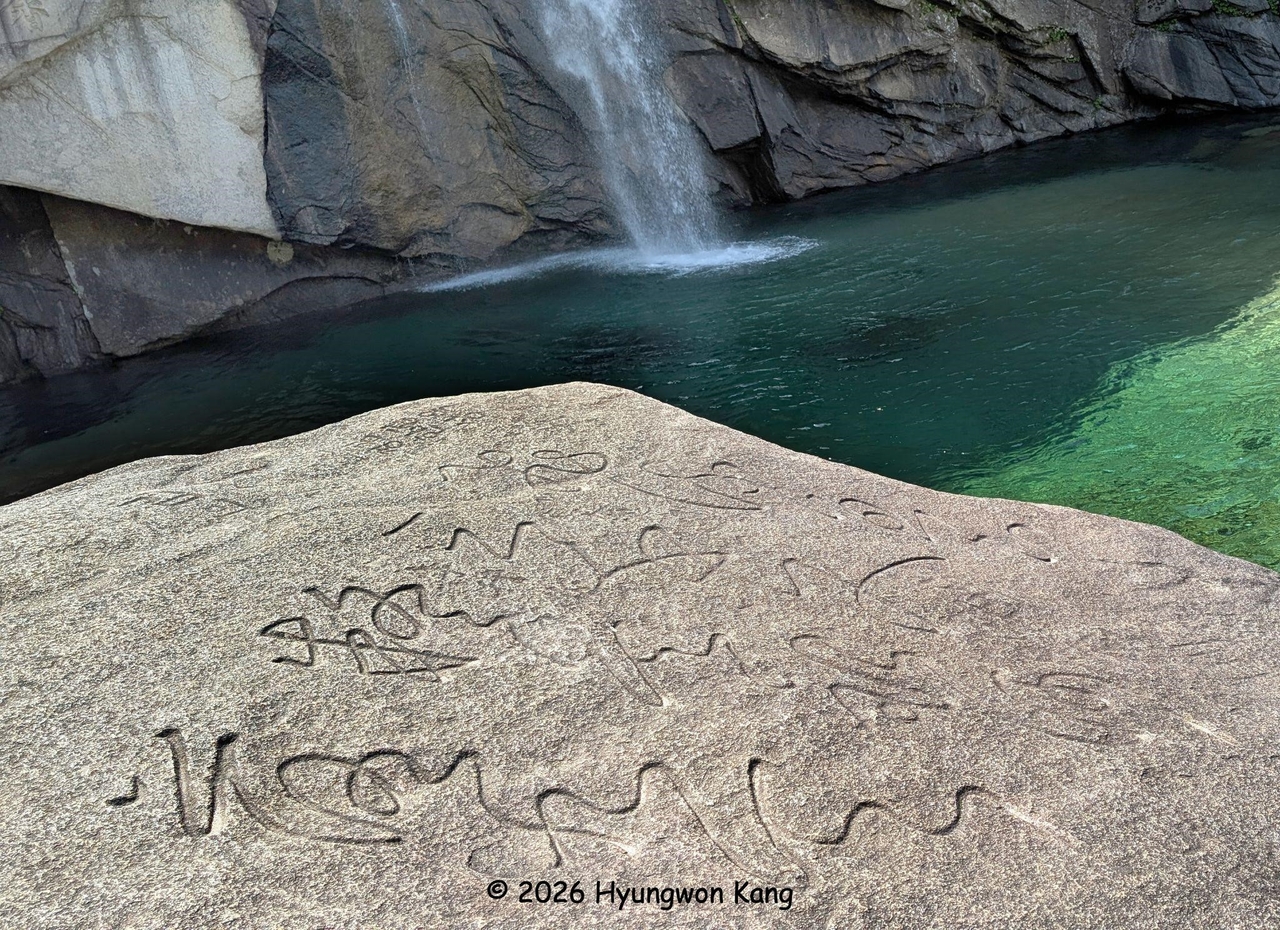
Hwang Jin-i’s celebrated sijo, “Cheongsanli Byeoggyesuya (O Turquoise Stream Among the Green Mountains)", offers a quieter invitation:
O turquoise stream, don't brag about how fast you flow away.
Once you reach the vast ocean, it is hard to ever return.
The bright moon fills the empty mountain, so why not stay and rest a while?
“Turquoise stream” also refers to the royal kinsman Byeokgyesu; “bright moon” is Hwang herself. Flirtation becomes a meditation on time: Youth, love and life cannot be reclaimed once they pass.
For our competitive, hurried world, her question still resonates: Why rush past the life you are trying so hard to live?
By Hyungwon Kang
Hyungwon Kang is a Korean American photojournalist, columnist, author and two-time Pulitzer Prize winner. He reported from North Korea in 1995, 1997 and 2026. Kang is the author of "Visual History of Korea" and "Seonbi Country Korea, Seeking Sagehood." His ongoing Visual History of Korea project documents Korean history and culture across the Korean Peninsula for global audiences. He currently teaches “Visual Literacy A to Z” at Dongguk University.
The views expressed in this article are the writer’s own. — Ed.
cheesuk@heraldcorp.com
- The three treasures of Kaesong: A waterfall, an artist and a sage
- Defense minister rejects criticism of passivity, vows firm stance on provocations
- Unification Minister calls on Pyongyang to meet to discuss MDL
-
AMD's Lisa Su courts Korean AI chipmakers as it takes on Nvidia
x
-
Korea plans easier visa rules for Korean-speaking students, new gap-year track
x
-
Jennie vs. Annie: Lotte-Shinsegae rivalry gets K-pop duel
x