
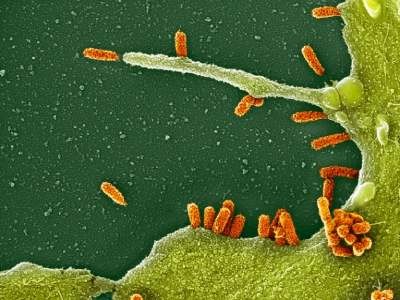
A variant of the H1N1 influenza virus is dominating flu season in the Northern Hemisphere so far this year. Shown here are H1N1 influenza virus particles (yellow) releasing from an infected lung cell (green).Credit: Science Photo Library
Data show that flu season in the Northern Hemisphere might be off to an early start — prompting a rethink about when people should get their annual vaccines against the influenza virus. The percentage of positive tests for influenza is unusually high for this time of the year in places such as the United Kingdom and on the West Coast of the United States (see ‘Surprising start’). In Japan, outbreaks in August and early September forced some schools to close just as they were starting back up after the summer break.
“It would be an incredibly early season” for the United States if the cases researchers are seeing on the West Coast continue to rise at their current rate, says Scott Hensley, a virologist at the University of Pennsylvania in Philadelphia.
The influenza subtype responsible for most of the US cases so far is H1N1, in a flip from last year, when H3N2 dominated. And sequencing data from these early cases point to an emerging mutation in H1N1 that is causing concern among specialists.

Source: Adapted from US Centers for Disease Control and Prevention data
These findings come from a relatively small number of positive tests compared with those available during peak flu season, so it’s too soon to predict the overall trajectory of the outbreak, researchers say. “An early start doesn’t necessarily mean a more severe season,” says James Hay, an epidemiologist at the University of Oxford, UK. Still, “there is something afoot”, wrote epidemiologist Caitlin Rivers in her newsletter, ‘Force of Infection’, on 27 September.
It’s enough to make Rivers, who is a researcher at Johns Hopkins University in Baltimore, Maryland, reconsider her personal protection strategy. In a typical year, when flu season peaks in December and January in the United States, she would wait until mid-to-late October for a shot, to get the best protection. Now, she’s thinking about getting a jab as soon as possible.
An emerging mutation
Seasonal flu is usually caused by some combination of three viruses: two subtypes of influenza A — H3N2 and H1N1 — and influenza B. Because influenza viruses genetically mutate over time and people’s immunity alters as they get vaccines and infections, which of the three viruses emerges as dominant changes for each flu season. US data showed that, during the week ending on 26 September, H1N1 accounted for 96% of positive cases for which subtyping was performed. H3N2 accounted for almost 4% of cases, and influenza B wasn’t detected.
That’s in contrast to last year, when a new variant of H3N2, called subclade K, emerged. It became globally dominant because it had many mutations that made people more vulnerable to it.
Will the mRNA flu shot work better than a regular seasonal one? What the science says
This year, the H1N1 mutation that is worrying researchers is G155E. Alex Greninger, a virologist at the University of Washington in Seattle, says that his laboratory detected G155E in 13 of 17 H1N1 samples taken from people in whom the genetic sequences were complete enough to identify specific mutations. The samples had come from hospitals and clinics in Seattle over the past few months.
This mutation had already been flagged in an analysis led by Jesse Bloom, a virologist at the Fred Hutchinson Cancer Center in Seattle, which was posted on the preprint server bioRxiv last month, ahead of peer review1.
Bloom and his colleagues tested how well antibodies in blood samples from 260 people in Australia and the United States were able to recognize and block infection from 148 influenza A viruses circulating by mid-2026. “We saw that a number of strains which have the G155E mutation are, in some cases, less well recognized by pre-existing human antibodies,” Bloom says. Antibodies in serum from teenagers and young adults were especially inept at recognizing this variant, probably because many in these groups haven’t been exposed to H1N1 viruses with similar characteristics before.