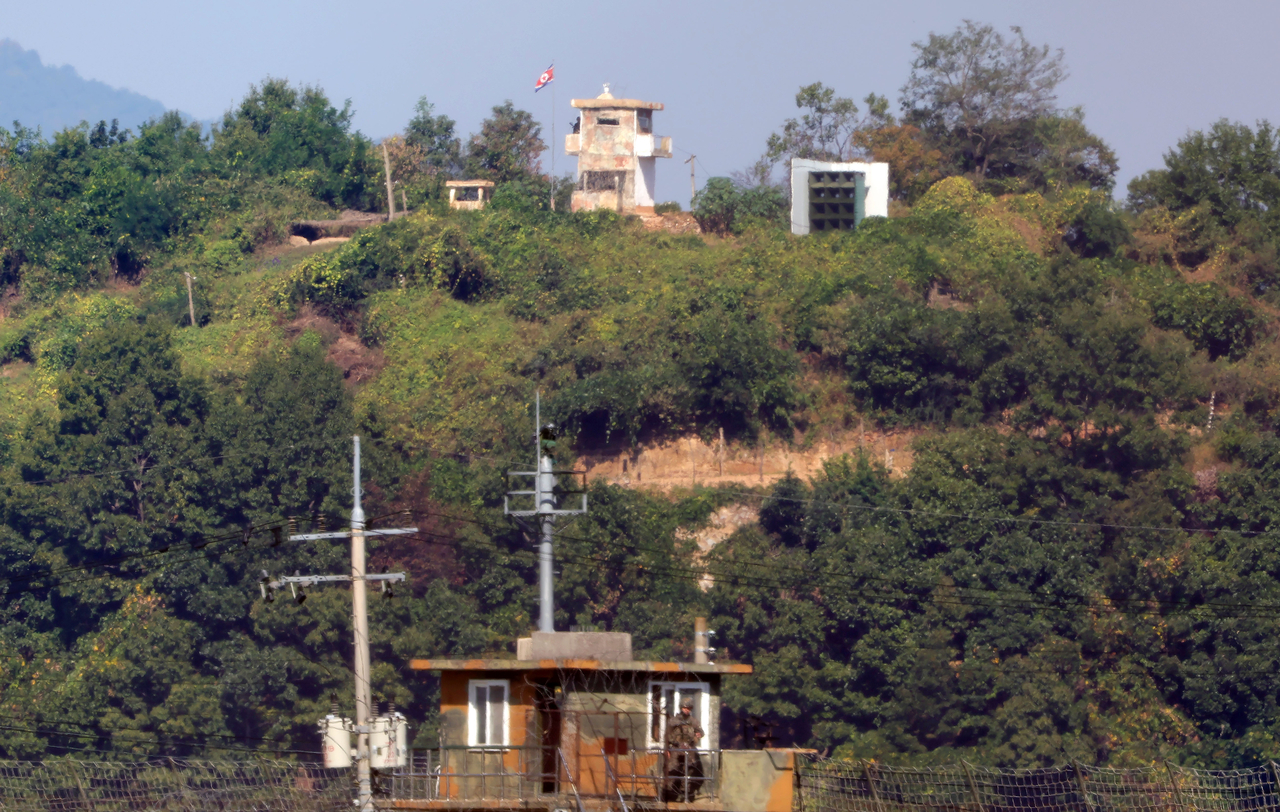
South Korea's military kept front-line Army units ready to open fire at short notice following two Sept. 21 mine explosions in the Demilitarized Zone, as a precaution against any unexpected North Korean military action, sources said Tuesday.
According to military sources familiar with the matter, the Joint Chiefs of Staff raised the corps-level fire readiness posture shortly after the explosions, which injured three South Korean military personnel near the Military Demarcation Line.
The heightened posture remained in place through Monday, when the military completed an operation to remove a North Korean minefield found south of the MDL.
Monday's operation was the first time the South Korean military had carried out a physical operation to remove a North Korean minefield south of the MDL, according to the Ministry of National Defense.
A military official familiar with the matter said the heightened posture reflected concerns that explosions and mine removal near the MDL could prompt an unexpected North Korean reaction.
"From our perspective, detonating mines may not seem like a particularly significant action, but from North Korea's perspective, explosions were taking place right in front of what it considers its boundary," the official said on condition of anonymity.
"There was a possibility of casualties, and the explosions themselves could also have appeared threatening visually. We did not know what might happen, so the posture was raised to prepare for any possible situation," the official said.
The heightened measure was also reported to Defense Minister Kang Shin-chul, according to the source.
The fire readiness posture is designed to shorten the time needed for front-line forces to respond with firepower if an enemy takes military action. Raising the posture generally places personnel and weapons systems at a higher level of readiness, allowing units to conduct fire missions at short notice.
Similar measures have been taken during previous periods of heightened inter-Korean tensions, including in 2022, when North Korea fired a ballistic missile south of the Northern Limit Line, and in 2024, when Pyongyang ordered front-line artillery units to prepare for possible fire missions.
The JCS declined to confirm whether the posture had been raised or which Army corps had been placed on heightened readiness, citing operational security.
The disclosure comes amid criticism that Seoul has taken few visible measures against North Korea even after the military concluded that Pyongyang had planted the mines south of the MDL and warned that it would take "corresponding measures."
The defense minister rejected criticism Tuesday that Seoul's response had been overly passive or defensive, pointing to Monday's mine removal operation.
"It was, in fact, the first such case in the history of our DMZ, and I see it as a resolute response," Kang told reporters before attending a Cabinet meeting.
In 2015, South Korea resumed loudspeaker broadcasts toward North Korea after two South Korean soldiers were severely wounded by North Korean wooden-box mines inside the DMZ.
The option of restarting loudspeaker broadcasts was also considered following the latest mine incident, but was ultimately not adopted.
On Monday, after the JCS concluded that the mines had been deliberately placed and assessed that they had been installed more than 12 months earlier, a Defense Ministry official said loudspeaker broadcasts were not among the corresponding measures Seoul had decided to take.
"When considering a measure, we have to assess its effectiveness — whether it actually produces the intended effect," the official said.
"In that respect, we assessed the effectiveness of loudspeaker broadcasts somewhat differently from what people might generally think," the official said, citing the burden such broadcasts could place on South Korean residents living near the border, including noise.
flylikekite@heraldcorp.com