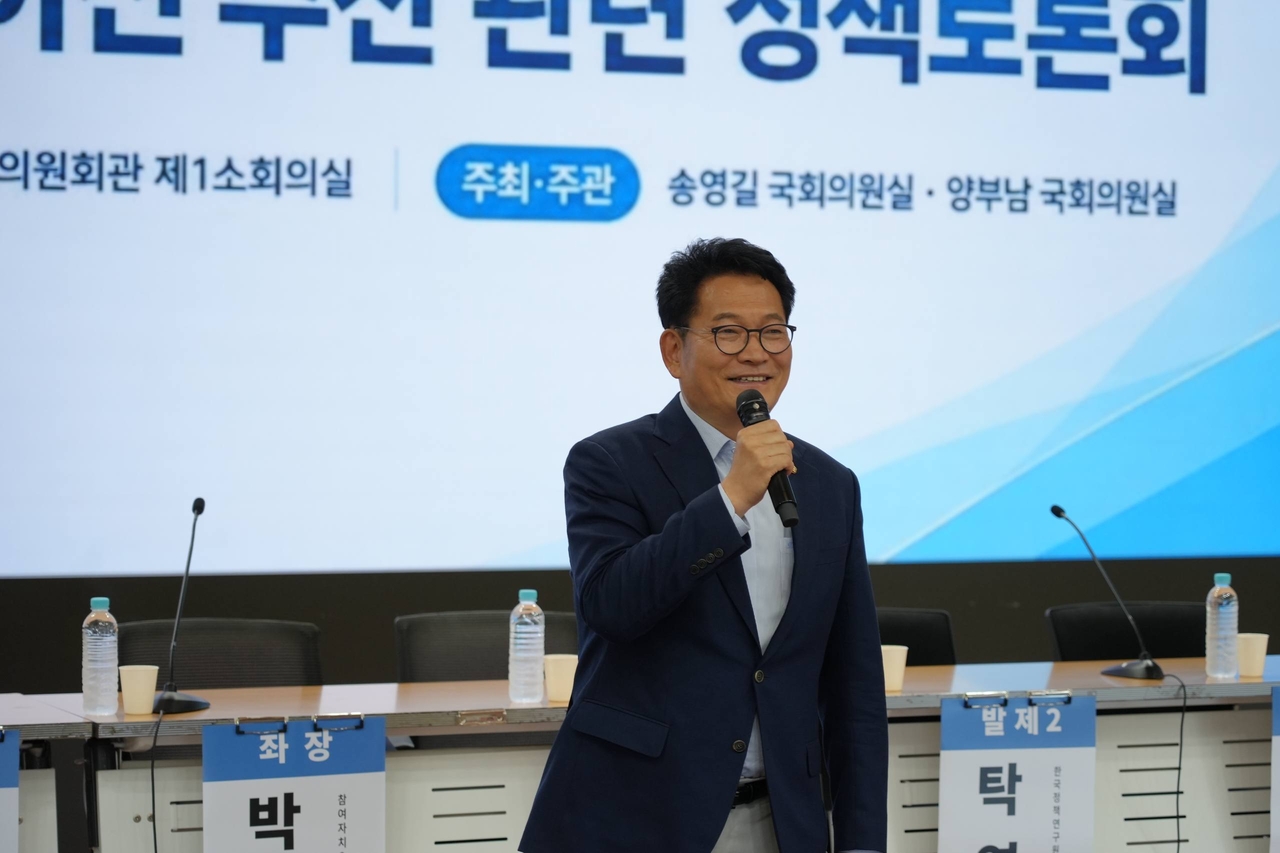
Rep. Song Young-gil, a six-term lawmaker of the ruling Democratic Party of Korea, said Monday that the phased relocation of military forces stationed at the Gwangju Air Base to one in nearby Muan-gun, in Jeonnam-Gwangju, could be an alternative to the current reloation plan that has hit a snag.
In a parliamentary forum held at the National Assembly on Monday, Song stressed that the key to expediting the relocation process would be to put a wider range of options into consideration.
"Instead of sticking to the existing plan, we should be open to quicker, safer and more economical options (for the relocation)," Song said in the forum.
Song cohosted Monday's forum with with Democratic Party Rep. Yang Boo-nam, who represents Seo-B constituency in Gwangju.
According to Song, there could be an alternative to the current plan by the government to relocate military forces stationed in the Gwangju Air Base to three air bases in Yecheon, Seosan and Chungju in the Chungcheong provinces.
"The current plan to deploy military forces in Gwangju across three sites faces realistic challenges, such as objections from the local residents and the operational continuity of the military forces," he said.
"Decisions must be based on a comprehensive assessment ... rather than simply placing the burden onto a specific area."
One could be the relocation of military forces to Muan Airport, which has suspended operations since a deadly plane crash in December 2024. That would involve an expansion of the airport site to accommodate military forces through a phased approach.
The relocation will allow the site of the Gwangju Air Base to be emptied and turned into a semiconductor plant under the liberal Lee Jae Myung administration's signature "megaproject" to spur regional growth.
"Resolving the military airport relocation issue at an early stage is essential for the timely establishment of the semiconductor cluster," he said.
Jeonnam-Gwangju has long been considered a liberal stronghold, even before the merger of the two regions earlier this year.
The relocation would be a task that would determine the country's fate, Song said in the forum, adding the success of the South Korea's national security, regional economic growth and the national industrial development strategy lies in the relocation.
"Discussing how to make use of the Muan International Airport and coordinate the functions of the military and commercial airports there can no longer be overlooked," he said.
Song added he would examine the feasibility of the Gwangju Air Base's relocation to Muan Airport in the upcoming parliamentary audit.
consnow@heraldcorp.com