Questions raise fairness of exemption clause, which benefits athletes but not global K-pop stars like BTS
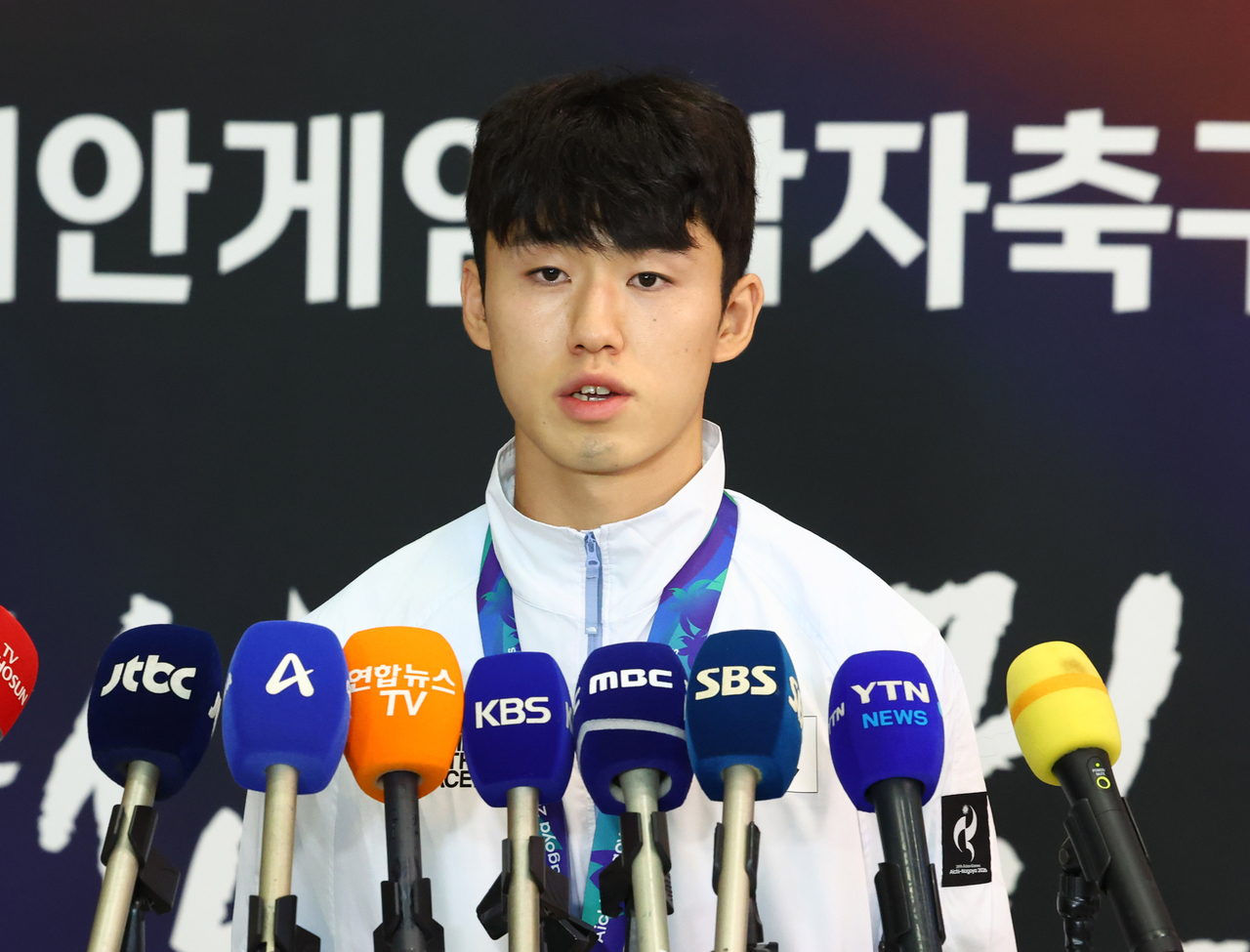
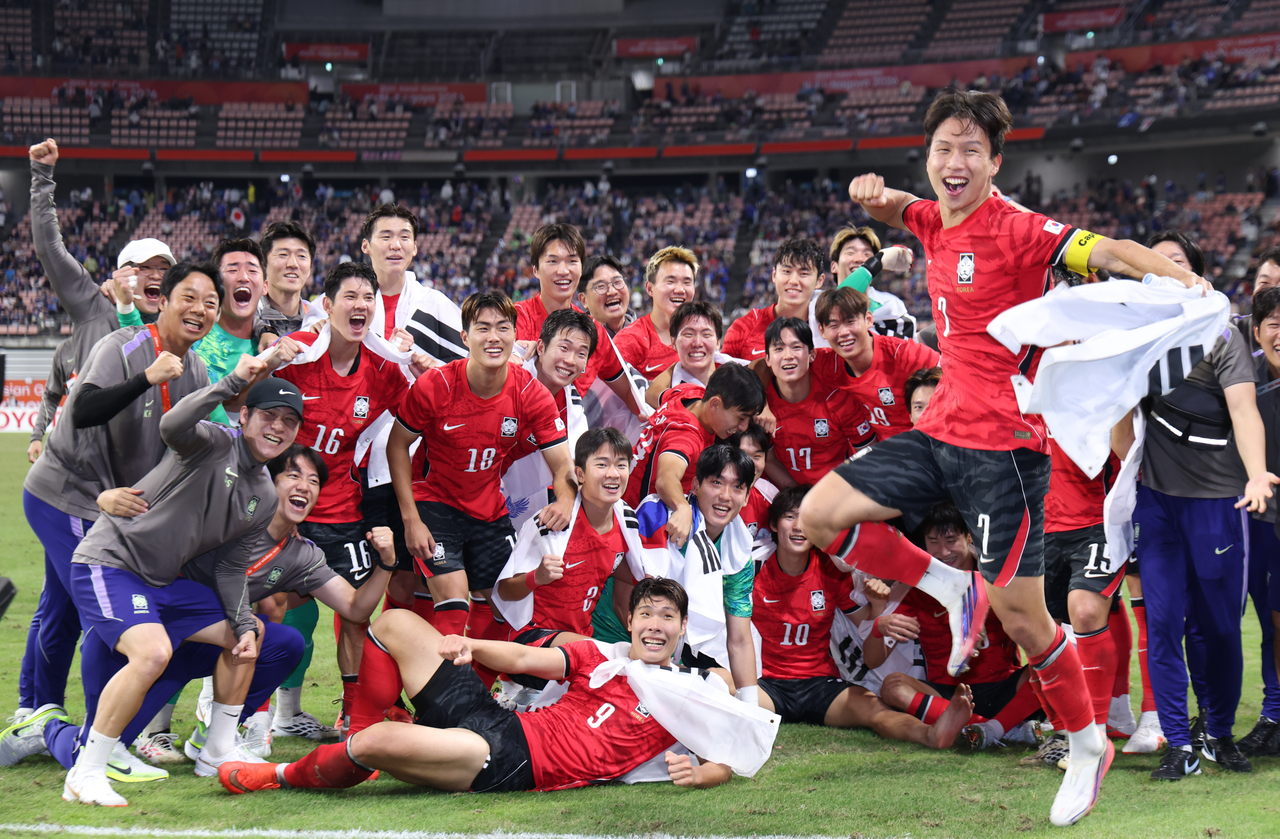
South Korea’s U-23 men’s soccer team returned home Sunday with a fourth consecutive Asian Games gold medal, but the celebrations were quickly overshadowed by backlash over players’ remarks about the military service exemptions that came with their victory.
Team captain Lee Gi-hyuk, a 26-year-old defender for K League 1 club Gangwon FC, apologized for his controversial comment about avoiding the madatory service upon arriving at the Incheon Airport on Sunday. The team defeated Japan 1-0 in the Asian Games final at Toyota Stadium in Aichi, Japan, on the previous day.
“I should have thought about the weight my words carried as captain and should have spoken each phrase with that responsibility in mind,” Lee said in a separate statement posted on social media. “I am sincerely sorry to our fans that I did not do that.”
“I think I have disrespected and hurt our fans and those faithfully serving their military duties,” he added.
The controversy has once again placed South Korea’s decades-old military service benefit for elite athletes under scrutiny, reviving questions over whether a system introduced more than half a century ago to reward achievements deemed to enhance national prestige still fits today’s notion of fairness.
Under the current system, Olympic medalists and Asian Games gold medalists can be designated as arts and sports personnel rather than serve as active-duty soldiers.
Although commonly described as a “military exemption,” recipients undergo three weeks of basic military training and spend 34 months continuing activities in their respective fields, while completing 544 hours of public service using their professional skills.
‘I only played for military exemption’

Four players were at the center of the backlash.
“I’m not going to the military,” Lee said in a post-match interview, smiling as he held up his gold medal.
Lee added that he felt as though “a burden had been lifted," as he had been scheduled to enlist just nine days after the Asian Games had South Korea failed to win gold.
Yang Min-hyeok, a 20-year-old winger for Belgian club Westerlo, drew further criticism when he told reporters that “the medal or trophy was not important.”
“There was the reward of military exemption, so I played with only that goal in mind,” Yang said.
The backlash intensified as other players posted celebratory images on social media.
Park Seung-soo, a 19-year-old Newcastle United midfielder, uploaded a selfie wearing a military discharge cap, a type commonly worn by soldiers completing their service. Park had played a total of only 16 minutes across three substitute appearances during the tournament.
Choi Woo-jin, a 22-year-old left back for Jeonbuk Hyundai Motors, also came under fire after posting a video in which he appeared to limp toward the camera before removing his shoe, from which a gold medal slid out.
Some online users said the performance evoked the soldiers recently injured in twin mine explosions near the Demilitarized Zone, although Choi denied the interpretation and said he was recreating a meme circulating overseas.
All four players eventually issued apologies.
Players or an outdated system?
Public reaction has been divided between criticism of the players’ conduct, and questions over whether young athletes are bearing the brunt of anger that is fundamentally directed at the system itself.
“I understand that this is insensitive, but aren’t we expecting too much from young players if we expect them to think of all of these events in relation to one another?” one user wrote on Threads, referring to criticism of Choi’s video.
Others argued that the episode demonstrated why athletic achievement should no longer be linked to military service.
“Winning a medal at an international event is a personal feat. Why is it a national feat?” another user wrote. “The idea of enhancing national prestige is so outdated.”
The dispute has also moved into the political sphere, with lawmakers across the aisle calling for legal reform.
"Earning a gold medal at the Asian Games is a big accomplishment and deserving of applause, but military exemption is a separate problem," said ruling Democratic Party of Korea Rep. Chung Il-young. "As time progresses, the standards must also change."
People Power Party lawmaker Ahn Cheol-soo called Sunday for the military service benefit granted for Asian Games gold medals to be reconsidered, criticizing what he described as disrespect toward those completing their military duties.
“It is time we review the military exemption system for the Asian Games,” Ahn said on social media.
Fellow PPP lawmaker Na Kyung-won took a different approach, arguing that the controversy pointed less to individual players than to rules that created such powerful incentives.
“We should not blame the athletes,” Na wrote. “Their honesty was made by the system.”
“The problem is not with the athletes but with an old system.”
Na said there was a stronger rationale for rewarding international sporting achievements when the program was introduced in 1973, when Korea was seeking to raise its international profile through sports.
But the country’s global standing has changed dramatically since then, she said, citing K-pop, dramas, semiconductors, smartphones and automobiles as examples of areas through which Korea is now known internationally.
She also pointed to South Korea’s shrinking pool of military-age men as another reason to reconsider the scope of special treatment.
An old argument over fairness

The Asian Games have remained an especially frequent source of controversy because a single gold medal can determine whether a professional athlete loses more than a year of his competitive career to active-duty service.
The issue erupted prominently during the 2018 Jakarta-Palembang Asian Games, when questions were raised over whether some military-eligible professional baseball players had been selected in part to give them an opportunity to secure the benefit.
LG Twins infielder Oh Ji-hwan became a particular focus of criticism after postponing military service and then being selected for the national team, which ultimately won gold.
But the system has also drawn criticism from outside sports.
In the arts, winners of designated domestic and international classical music, dance and other competitions can qualify for arts personnel status. Popular entertainers, however, do not become eligible simply because of commercial or international success.
That distinction became particularly contentious during the debate over BTS.
Despite topping major global music charts and playing a central role in the international expansion of K-pop, the group’s members were not eligible for arts personnel status.
All seven BTS members ultimately fulfilled their military obligations, with six serving on active duty and Suga serving as a social service agent.
Why abolition is not so simple
For athletes in less commercially prominent sports, however, the system is crucial.
In sports with limited professional leagues or sponsorship opportunities, such as gymnastics, wrestling and canoeing, the Olympics and Asian Games can represent the pinnacle, and sometimes much of the economic basis, of an athlete’s career.
With elite athletic careers often short, an interruption of more than a year during an athlete’s early or mid-20s due to their military service can have consequences that extend far beyond lost income.
That distinction is one reason proposals to reform the system have ranged from abolishing Asian Games exemptions altogether, to replacing the current winner-takes-all approach with a points-based system that takes into account achievements accumulated across multiple international competitions.
seungku99@heraldcorp.com