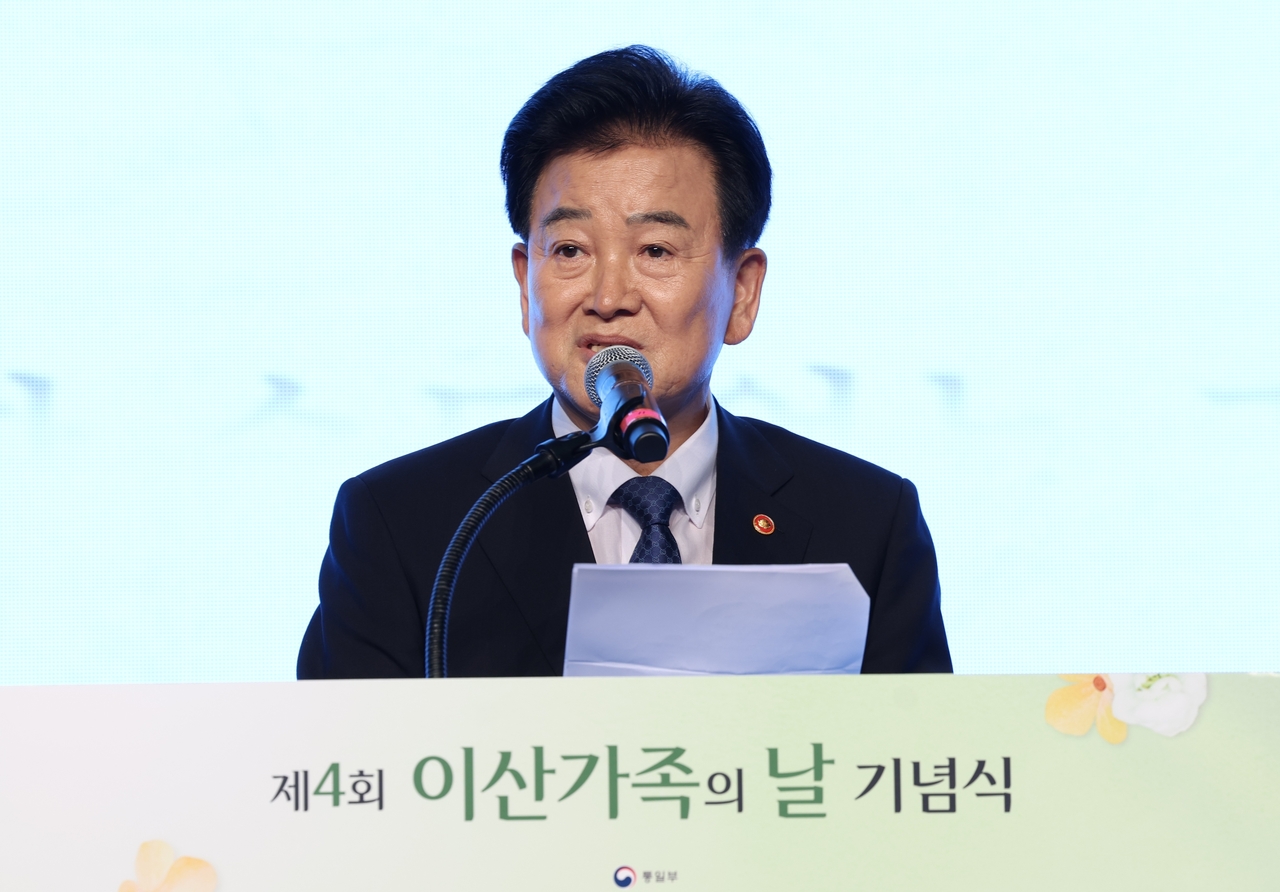
Unification Minister Chung Dong-young on Thursday called for a thorough investigation and appropriate measures in response to a recent land mine explosion in the Demilitarized Zone, while cautioning against politicizing the incident.
"Rather than engaging in wasteful political disputes, we must deeply reflect on why such tragic incidents continue to occur and seek fundamental solutions," Chung wrote on Facebook.
"A thorough investigation should establish the facts, and appropriate measures will need to be taken based on the final results," he said. "However, this must not become a pretext for disparaging or distorting our efforts toward peace on the Korean Peninsula."
His remarks came amid heightened inter-Korean tensions over two explosions that occurred Sept. 21 inside the western section of the DMZ, injuring three South Korean soldiers, two of them critically.
The South Korean military said in its interim investigation that North Korean land mines were "highly likely" to have caused the explosions. A joint investigation by the South Korean military and the United Nations Command also discovered a live North Korean antipersonnel mine on the southern side of the Military Demarcation Line, the de facto border between the two Koreas.
The UNC separately determined that an Armistice Agreement violation had occurred and said it was addressing the matter through established armistice mechanisms.
South Korea's Joint Chiefs of Staff has demanded an apology and "responsible measures" from Pyongyang, while Defense Minister Kang Shin-chul told lawmakers that the mines found near the site were believed to have been deliberately planted rather than washed across the MDL.
North Korea has rejected Seoul's findings.
Kim Yo-jong, a department director of the Workers' Party of Korea Central Committee and the powerful sister of North Korean leader Kim Jong-un, dismissed the South Korean account as a "clear farce" in a statement Wednesday and accused Seoul of seeking a pretext for military provocation.
The incident has also become a source of growing political friction. The main opposition People Power Party accuse the Lee administration of responding too cautiously to North Korea and called for stronger measures. The ruling Democratic Party, for its part, accused the PPP of politicizing national security before the investigation is complete.
Chung, a longtime advocate of inter-Korean engagement, invoked Northern Ireland's experience as an example of how deeply entrenched conflict can be addressed through political compromise.
Referring to the 1998 Belfast Agreement, also known as the Good Friday Agreement, Chung said political leaders' determination to pursue peace had helped transform decades of conflict.
"Through power-sharing and a coalition government, the people of Ireland are demonstrating that people can coexist and live together even when they have different views and identities," he added.
The Belfast Agreement, signed in 1998, helped bring an end to decades of terrorist violence known as the Troubles and established a power-sharing system in Northern Ireland.
"Here in Northern Ireland, which has transformed the tragedies of the past into hope for today, I renew my determination to end the long war on the Korean Peninsula and establish a permanent peace regime," Chung said.
"That is the only and fastest path to ensuring that our young people in the prime of their lives are no longer sacrificed and that we can reach confidently beyond the DMZ and out toward the continent."
Chung's remarks came as he cut short an official trip to Europe to return to Seoul amid the escalating dispute over the mine explosions.
He had originally planned to visit Northern Ireland, Ireland and Germany through Oct. 5 to study their experiences in conflict resolution, peacebuilding and coexistence. He canceled the Ireland and Germany legs of the trip and was set to return home Thursday to respond to developments surrounding the DMZ incident.
mkjung@heraldcorp.com