Business leaders and experts urge shift from fast follower to technology leader, drawing on strengths in chips and manufacturing
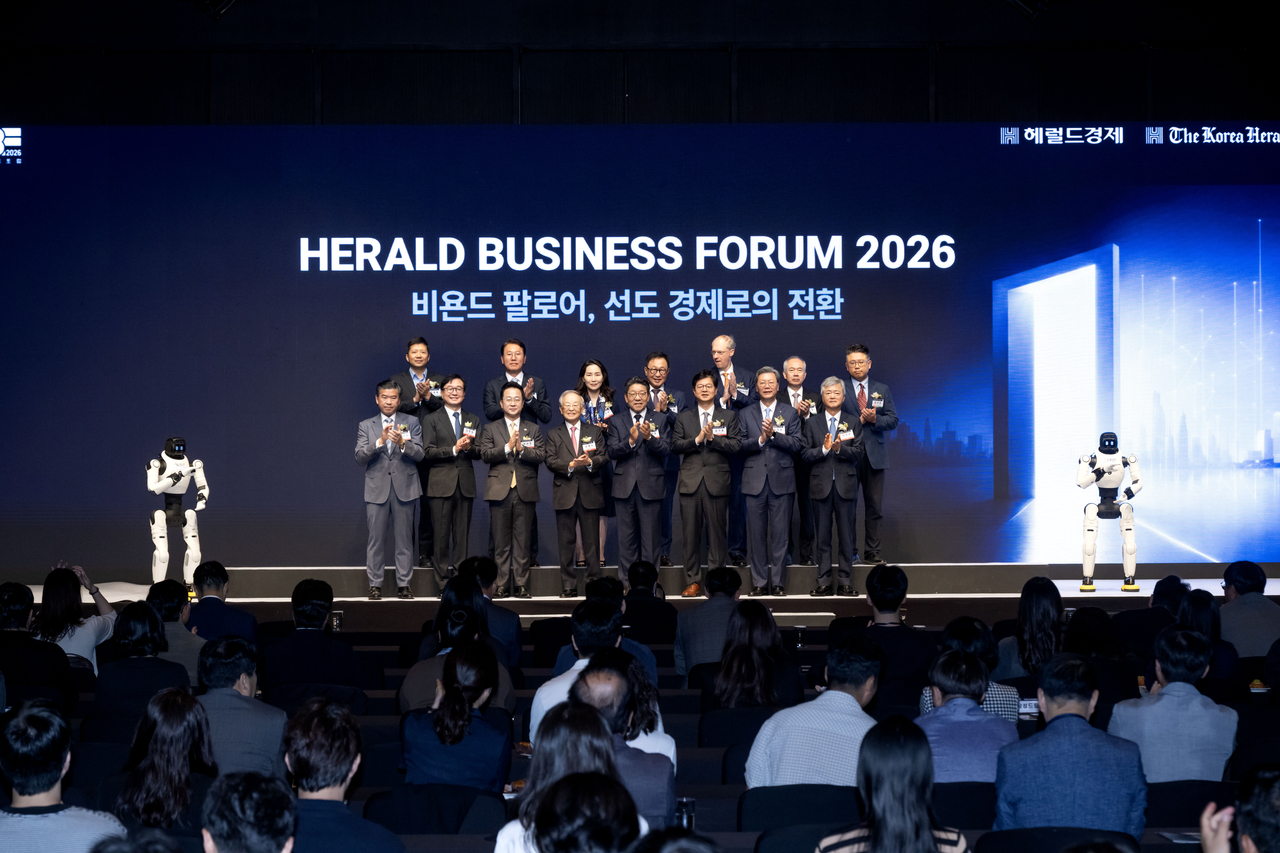
South Korea must turn its strengths in semiconductors and manufacturing into leadership in artificial intelligence, business leaders and technology experts said Tuesday, calling for a break from the fast-follower model that powered the country’s growth.
The message framed the Herald Business Forum 2026, hosted by Herald Media Group and organized by Herald Business at The Shilla Seoul. Held under the theme “Beyond followers, transitioning to a leading economy,” the forum explored how AI is reshaping industries from chipmaking and manufacturing to branding and space.
In his opening remarks, Herald Media Group CEO Choi Jin-young said Korea’s next stage of growth would depend on its ability to develop original technologies and set new standards.
“Simply following paths created by other countries is no longer enough. Korea must now create new technologies and new standards on its own,” Choi said.
He called for combining the country’s semiconductor capabilities, manufacturing expertise, digital infrastructure and talent with AI to strengthen its competitiveness.
President Lee Jae Myung echoed that call in a congratulatory message delivered by Seong Ghi-hong, senior presidential secretary for public relations and communication.
“The fast-follower growth strategy of rapidly adopting and advancing technologies developed by leading countries is no longer valid,” Lee said. “To become a global economic leader, we must boldly apply AI to industrial sites and build a strong ecosystem.”
American Chamber of Commerce in Korea Chairman and CEO James Kim highlighted Korea’s growing international influence, pointing to its role in supplying technologies the world needs and creating culture with a global following.
The keynote session examined the foundations of Korea’s AI ambitions.
Samsung Electronics senior adviser Jung Eun-seung emphasized that advances in AI would continue to depend on semiconductors, whose applications expand alongside human ideas and ambitions.
“As long as human imagination continues, semiconductors will continue to be needed,” Jung said.
Lee Jae-wook, professor of computer science and engineering at Seoul National University and director of the SNU AI Institute, outlined Korea’s opportunities across the AI value chain. He pointed to strengths spanning energy, chips, infrastructure and AI models.
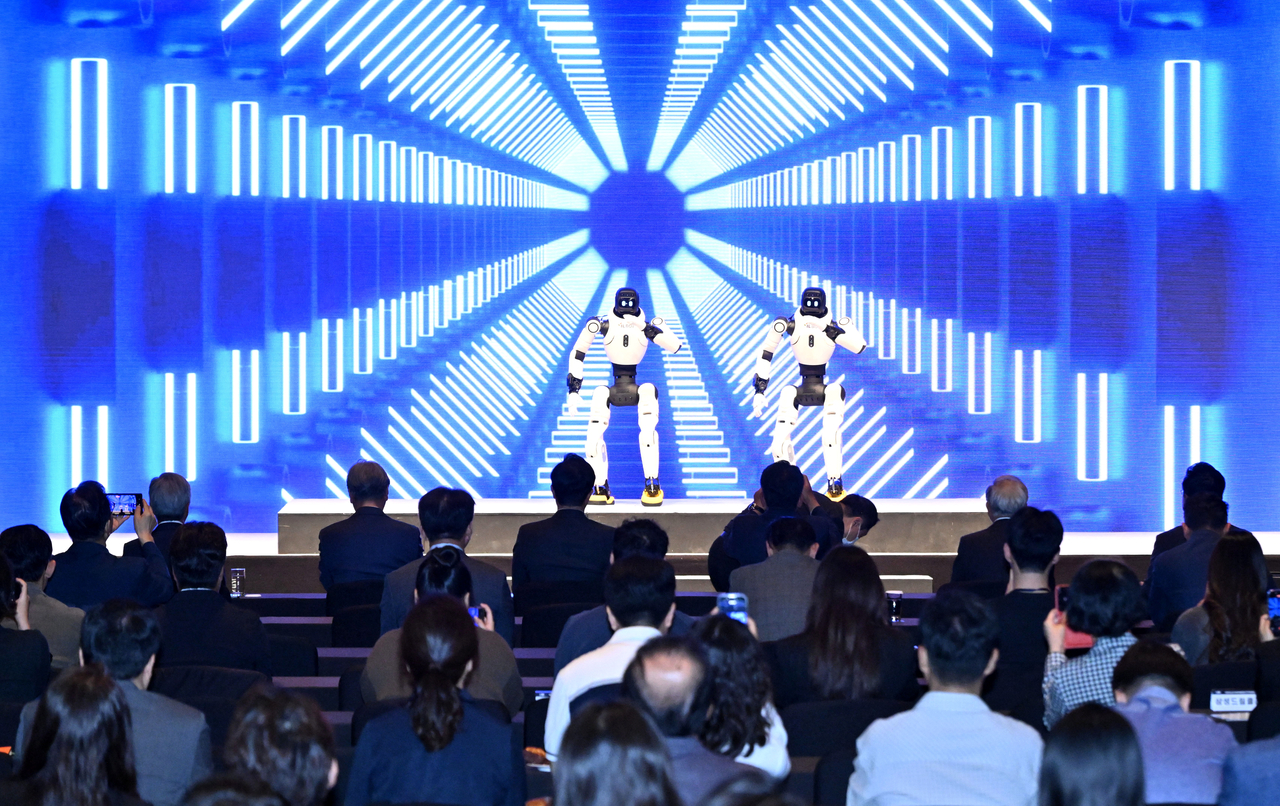
The first session, “The golden engine of the AI revolution: Semiconductors,” examined the technological changes needed to sustain that competitiveness.
Jusung Engineering Chairman Hwang Chul-joo urged companies to move from imitation to innovation. “New growth requires people who create new standards,” he said.
LG AI Research Vice President Lee Hwa-young discussed how agentic AI could reshape corporate operations through collaboration between people and AI systems. Lim Eui-cheol, vice president of solution AT at SK hynix, highlighted memory technology’s increasingly important role in advancing AI performance.
The discussion then shifted from computing to machines that interact with the physical world.
In the session “Physical AI, opens a new industry,” Jung Jun-cheul, president and head of the manufacturing division at Hyundai Motor Group, outlined the company’s approach to AI-powered production.
Kim Young-joon, head of the AI research lab in LG Electronics’ CTO division, explored the development of AI systems that can understand physical environments and act within them.
Lim Chie-hyeon, head of the group DX strategy office at Posco Holdings, emphasized using mission-oriented AI to solve specific industrial problems. Hyun Jang-suk, head of the technical program management team at Samsung SDI, discussed how battery technology would support the expansion of physical AI.
HD Hyundai group chief AI officer Kim Young-ok outlined the company’s strategy for integrating AI across industrial operations and accelerating manufacturing innovation.
A special session broadened the discussion to consumers, with Hino Consulting CEO Noh Hee-youn examining how brands should respond as AI changes customer experiences.
The closing session, “New space, a new path to growth,” explored opportunities beyond terrestrial industries. Seo Hyun-suk, chief of the space business group at Korea Aerospace Industries, and Kim Jong-pil, vice president at LIG Defense and Aerospace Satellite Mission Center, discussed Korea’s prospects in the expanding space economy.
yeeun@heraldcorp.com