 Moon Ki-hoon
Lee Chang-dong's Venice prizewinner is based on a 77-day sit-in at a Korean auto plant and the trauma it left behind
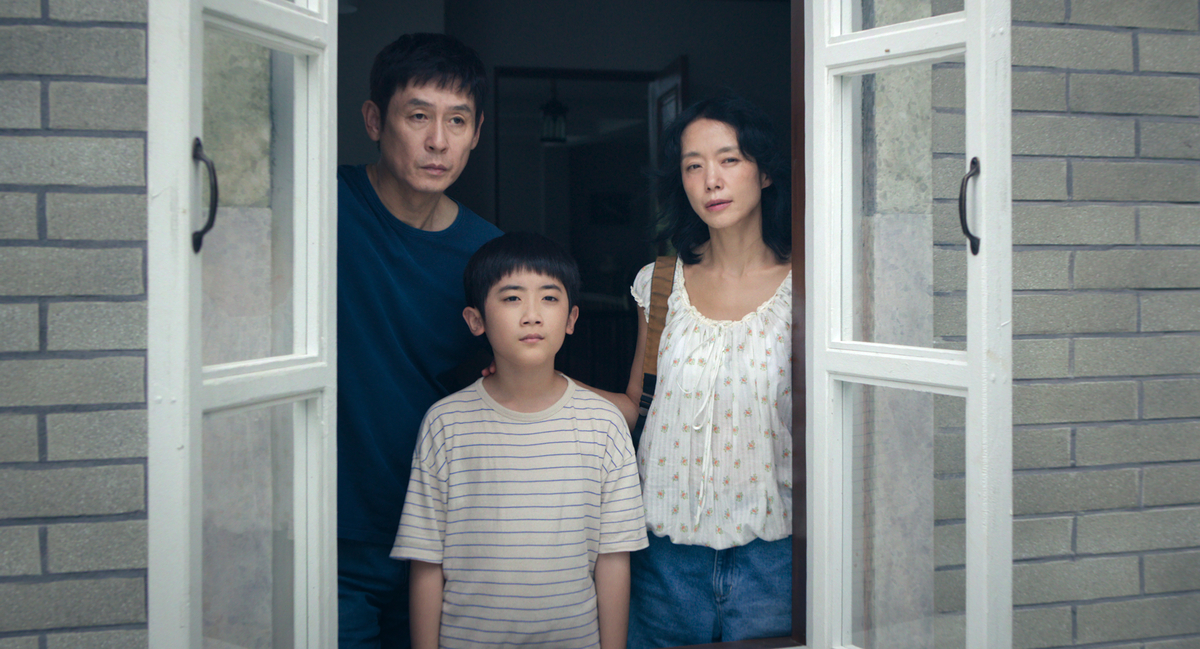
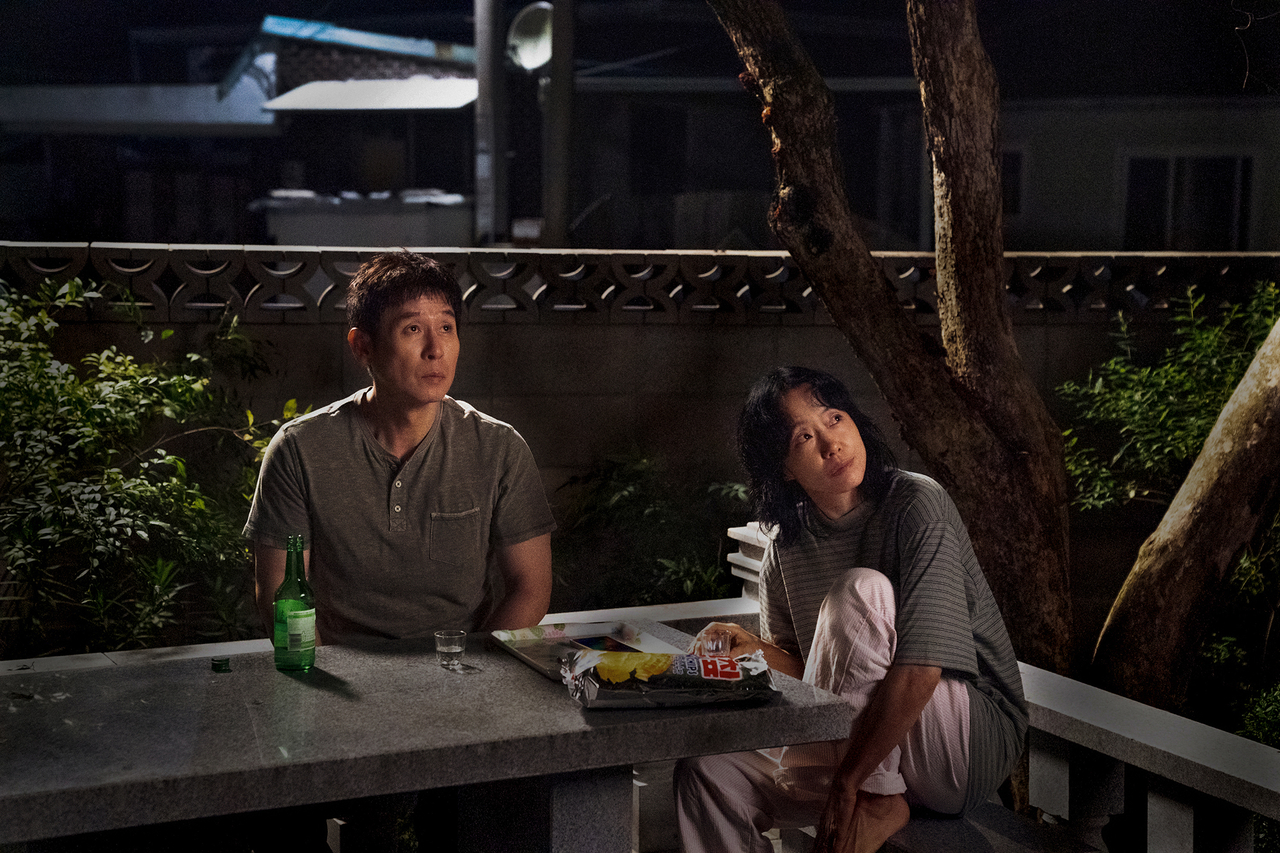
Ho-seok (played by Sul Kyung-gu), the laid-off welder at the center of Lee Chang-dong's Silver Lion winner "Possible Love," is a shell of the man he used to be. Stoic but warm, he used to have his co-workers at SP Heavy Industries over for drinks in his yard, treating them like brothers. Two years after losing his job, he barely speaks and drinks too much. He can't get through a counseling session for fired workers without bolting from the room.
His wife, Mi-ok (Jeon Do-yeon), meets a documentary filmmaker (Cho Yeo-jeong) at a former colleague's funeral, and Ho-seok reluctantly agrees to be interviewed for the film. The past comes out in pieces through the interviews and flashbacks that follow: He had joined a strike at the company, and the brutal police crackdown left him scarred for life.
When Ho-seok finally breaks his silence before the camera, his anger lands on his own side. "I'm sick of those people," he says. "Solidarity, struggle, workers' rights. I can't stand hearing any of it."
Lee has said in interviews that the story was inspired by "a strike at a major company 10 years ago." He never named which one, but viewers here won't need telling. From the riot police storming the factory roofs to the strikers' families holding out alongside them, the film's strike all but recreates the 2009 strike at Ssangyong Motor's plant in Pyeongtaek, south of Seoul.
It happens to be the same incident that shaped the Netflix sensation "Squid Game." The show's hero, Gi-hun, is a laid-off autoworker haunted by a co-worker's death in a police raid. Writer-director Hwang Dong-hyuk has said the character grew out of his experience watching the aftermath of the Ssangyong strike upend the workers' families.
How it began
Ssangyong was then Korea's fifth-largest automaker, and China's Shanghai Automotive Industry Corp. had held a controlling stake in it since 2004. Sales plunged in the wake of the 2008 global financial crisis, and the company filed for bankruptcy protection in January 2009. In April of that year, it announced plans to cut 2,646 jobs, or about 36 percent of its workforce.
In the film, SP is a heavy industry firm rather than a carmaker, and the layoffs come ahead of a sale to private equity rather than after a foreign owner pulls out. Yet the core of the story remains the same: The union rejects the layoffs, and workers go on strike and take over the plant, barricading themselves inside.
A standoff that lasted 77 days
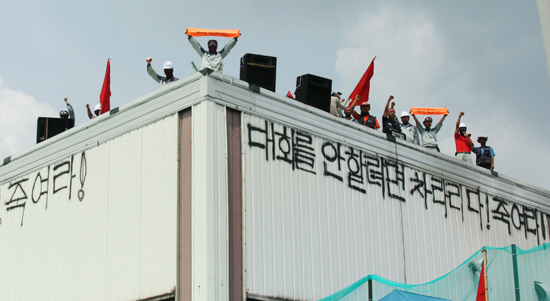
Within weeks, the standoff turned violent. In late June, thousands of non-striking employees tried to retake the plant and were driven back by strikers armed with steel pipes and forklifts.
In July, a court ordered the strikers out, and police began to seal the gates, cutting off water and food. Police helicopters sprayed water laced with tear gas over the roofs as strikers fought back with Molotov cocktails, burning tires and slingshots that fired steel bolts.
The film largely skips over the armed standoff and never shows strikers turning their own co-workers away at the gates, presenting the strike as a peaceful united front. It dwells instead on another side of the occupation, where wives and children join the strikers inside the fence and workers sing and dance at rallies to keep their spirits up.
In early August, police commandos were lowered by crane in shipping containers onto the roofs where strikers had dug in, and the holdouts fell back into a single building. News cameras caught officers beating strikers with batons and dragging them away, the same kind of assault that left Ho-seok badly wounded. Hundreds were injured on both sides.
With police in control of most of the plant, the union agreed on Aug. 6 to a deal that ended the occupation. Roughly half of those still holding out would go on unpaid leave with a promise to be rehired, and the rest would take voluntary retirement. The 165 who refused both options were fired. Dozens were arrested, including union leader Han Sang-gyun.
The reckoning
Court rulings that followed mostly went the company's way. Judges ruled the strike illegal, saying the workers had no right to seize the entire plant for weeks and fight off anyone who tried to get in. In 2014, the Supreme Court found the layoffs themselves legal. In 2023, it held the union responsible for the company's losses.
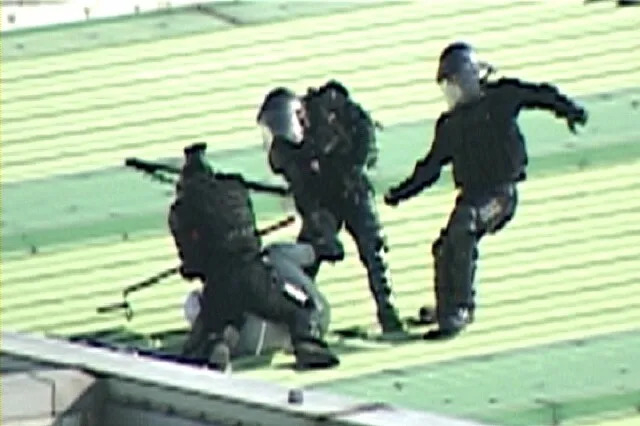
The police's handling of the strike prompted an outcry of its own. In 2018, an investigative panel set up by the police concluded that officers had used excessive force in breaking up the strike when they deployed helicopters and anti-terror weapons. In 2022, the Supreme Court significantly cut the damages the government could collect from the strikers, stating those who damaged police equipment may have been acting in self-defense.
'The dead and the living'
Public opinion on the strike remains divided, but its lasting toll on those who lived through it is hard to dispute.
Many fired workers said they were shut out of new jobs, and a 2015 Korea University study found that about half had shown symptoms of post-traumatic stress disorder after the strike. The union says more than 30 workers and family members died by suicide or from stress-related illness over the next decade.
As in the film, the bitterness between former co-workers was real. Some of the workers who kept their jobs had faced the strikers across the fence. The fired workers and those who stayed on came to call each other "the dead" and "the living," just as they do on screen.
Lee brings that tension to the surface in the group therapy scenes, where former workers take turns describing what the strike cost them, captured in long, unbroken takes. Played with remarkable conviction by the supporting cast, these scenes make for some of the most riveting stretches of the film, every bit as affecting as Ho-seok's own unraveling.
"Possible Love" ends as news breaks that SP has been sold to a private equity firm. For Ho-seok and his family, that spells the end of any hope of getting the job back.
At Ssangyong, however, the story didn't end there, and the fight dragged on for more than a decade. The company was sold to India's Mahindra & Mahindra in 2010, and a string of negotiations brought fired workers back in batches. A 2018 agreement promised to rehire everyone who remained.
The final group of 35 walked back through the factory gates on May 4, 2020, 11 years after the strike began.
moonkihoon@heraldcorp.com
- The strike that inspired 'Possible Love' — and 'Squid Game'
- Korean holiday hit about a 1974 assassination draws fire from conservatives
- Ha Chong-hyun, without the monochrome
-
UN Command says Armistice Agreement violation occurred over DMZ mine blast
x
-
[Exclusive] S. Korean Embassy to US woos Trump allies to expedite skilled visa talks
x![[Exclusive] S. Korean Embassy to US woos Trump allies to expedite skilled visa talks](https://wimg.heraldcorp.com/news/cms/2026/09/29/rcv.YNA.20260924.PGT20260924167001009_R.jpg?type=h&h=120)
-
BTS RM donates W100m to National Museum of Korea
x