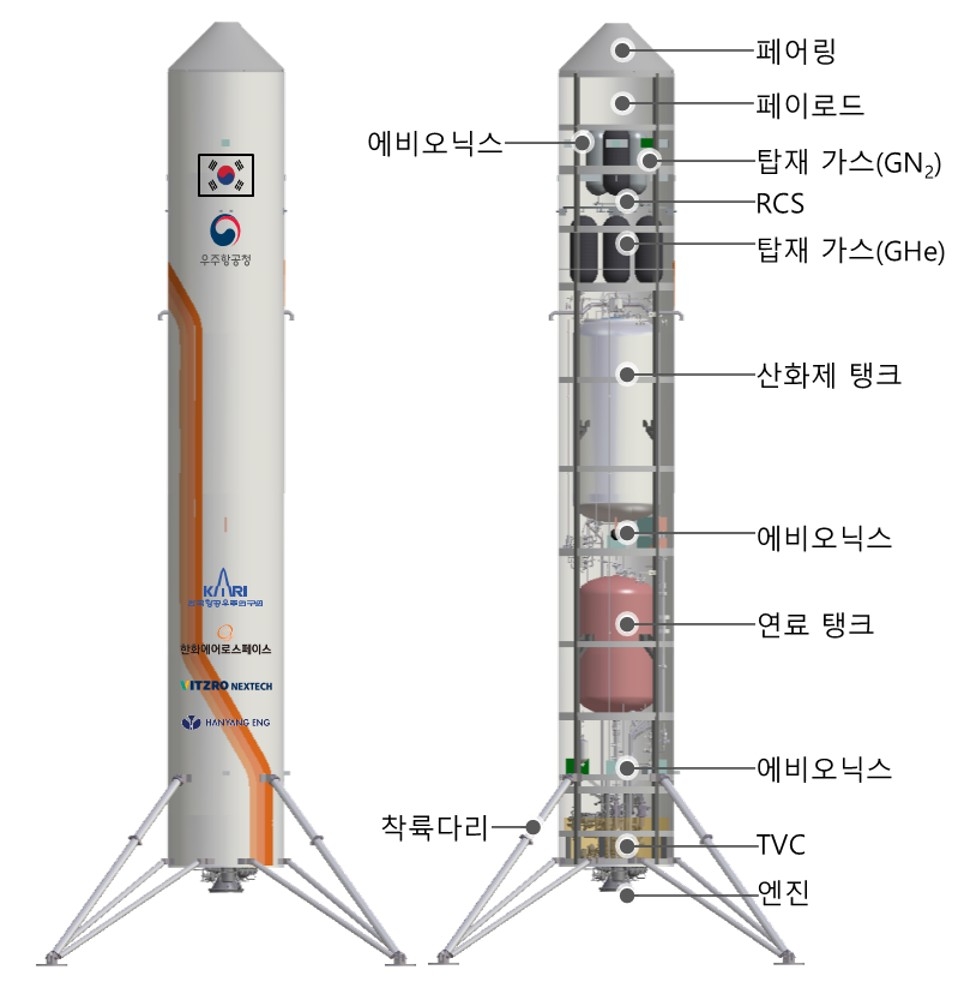
Hanwha Aerospace has begun assembling a reusable launch vehicle demonstrator as part of a project to secure key technologies needed to reuse rocket stages, a step toward lowering launch costs and strengthening South Korea's commercial space capabilities.
The Korea Aerospace Research Institute is leading the project, with Hanwha Aerospace responsible for overall system integration. Other Korean space companies, including Vitzro NexTech and Hanyang ENG, are also participating.
The demonstrator will stand 12.2 meters tall, measure 1.5 meters in diameter, and be equipped with a turbopump-fed staged-combustion engine with adjustable thrust. A flight test planned for 2028 aims to have the vehicle take off vertically, reach an altitude of 500 meters in about 90 seconds and land vertically at a designated site.
Hanwha Aerospace plans to use the project to test key technologies for reusable launch vehicles, including engine thrust control, attitude control and guidance. The company aims to complete the technology demonstration by 2028 and use the results as a foundation for reusing the first stage of its next-generation launch vehicle, planned for the mid-2030s.
Reusable launch technology is considered key to reducing launch costs. SpaceX has repeatedly reused the first stage of its Falcon 9 rocket, significantly lowering launch costs, while industry officials expect substantial savings even from reusing only the first stage.
Hanwha Aerospace plans to use the technology to improve cost competitiveness and accelerate its entry into the global space transportation services market.
“Developing reusable launch technology is essential for Hanwha Aerospace to grow into a ‘Korean SpaceX,’” a Hanwha Aerospace official said. “We will work with KARI and our partners to complete the project and contribute to strengthening Korea’s space transportation capabilities and private space industry.”
jyoungseon8@heraldcorp.com