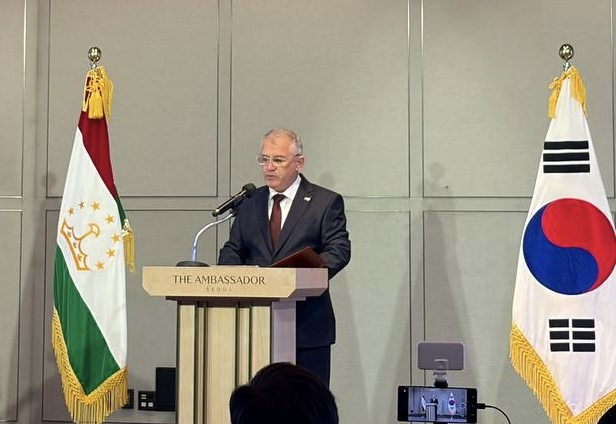
Tajikistan is looking to deepen economic cooperation with South Korea in critical minerals, investment and connectivity after the two countries established their first comprehensive partnership at a summit in Seoul this month.
Speaking at a reception in Seoul on Monday marking the 35th anniversary of Tajikistan's independence, Tajik Ambassador to South Korea Salohiddin Kirom described the upgrade as a "qualitative breakthrough" in bilateral relations.
He identified critical minerals and mining as a priority for the expanded partnership, saying Tajikistan could support South Korea's efforts to diversify supply chains for its high-tech, semiconductor and electric-vehicle battery industries.
"Tajikistan stands ready as a reliable, long-term strategic supplier," the envoy said, pointing to the country's reserves of strategic nonferrous and rare metals.
Kirom cited LS, GBI and Rexgen as Korean companies entering the Tajik market, describing their activities as a sign of growing business interest.
South Korean President Lee Jae Myung and Tajik President Emomali Rahmon established the countries' first comprehensive partnership during talks in Seoul on Sept. 16. Rahmon's visit was his first to South Korea in 11 years.
The summit produced 17 agreements and memorandums of understanding spanning railways and transport infrastructure, trade, digital technology, public administration and other areas.
The two sides also identified critical minerals as an area for further cooperation.
South Korea seeks to diversify supplies of key industrial materials and reduce vulnerabilities in supply chains supporting its semiconductor, battery and other advanced manufacturing industries.
The bilateral meeting was held alongside the inaugural Korea-Central Asia Summit, which brought together South Korea and the leaders of all five Central Asian states.
The six countries adopted the Seoul Declaration, setting out four areas for cooperation: institutionalizing the Korea-Central Asia partnership, promoting peace and stability, advancing innovation and prosperity, and strengthening connections through people and trust.
Kirom also called for closer transport links between Tajikistan and South Korea.
Tajikistan allows South Korean citizens visa-free entry for stays of up to 30 days, while the two countries are working toward establishing direct commercial flights, he said.
Direct air links could help increase bilateral trade, investment and tourism, he added.
Kirom also pointed to longstanding cultural links, citing the travels of eighth-century Korean Buddhist monk Hyecho through Central Asia as evidence of historical connections between the two regions.
The reception was attended by South Korean government officials, diplomats, business representatives, members of civil society, the Tajik community and foreign residents in Korea.
sanjaykumar@heraldcorp.com