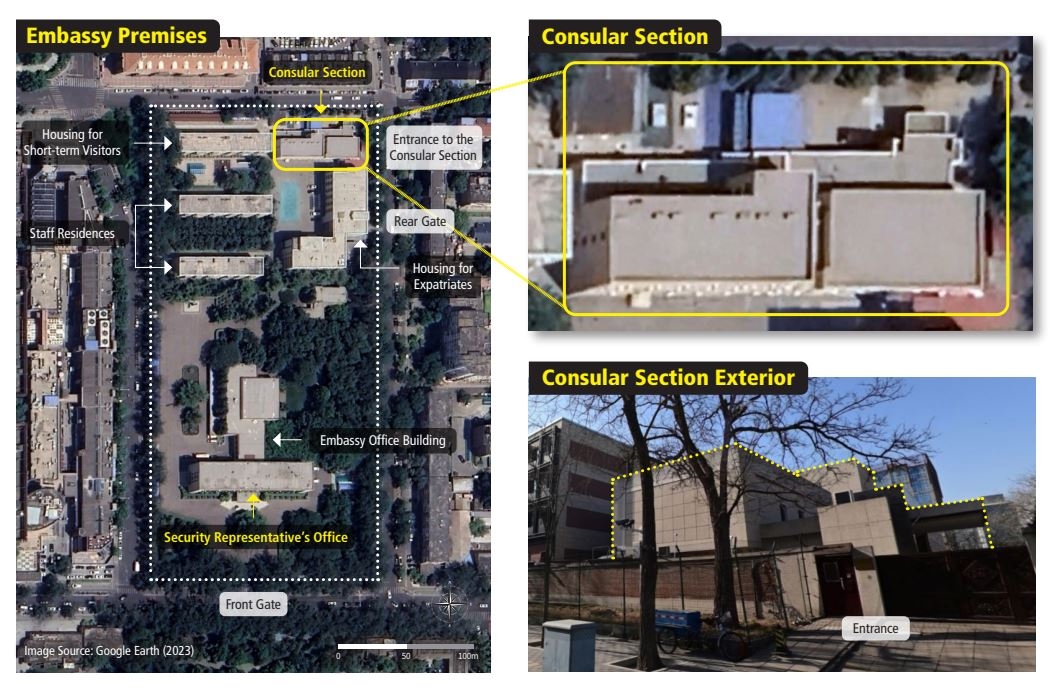
North Korea operates a secret detention facility beneath its embassy in Beijing where diplomats and other nationals suspected of attempting to defect are detained, interrogated and prepared for forced repatriation, a Seoul-based human rights watchdog claimed Tuesday.
The Transitional Justice Working Group said in a report that multiple sources had identified the basement of the consular section of the North Korean Embassy in Beijing as a “black site” used to hold people outside formal legal procedures.
TJWG said the facility forms part of a broader system through which North Korean security operatives monitor, track and forcibly return nationals deemed at risk of defection, describing the campaign as Pyongyang’s version of China’s “Operation Fox Hunt.”
The primary targets include diplomats, students studying abroad, party officials, weapons and scientific experts, hackers, overseas workers and others believed to possess sensitive information that could damage the North Korean leadership if disclosed, according to the report.
North Korean authorities sometimes lure suspected defectors to Beijing under false pretenses before detaining them inside the embassy, TJWG said. Their passports and mobile phones are confiscated and they are repeatedly interrogated in the basement facility.
“They are first detained at the embassy for a minimum of one week and a maximum of one month for the preliminary investigation,” a manager of North Korean workers in China was quoted as saying. “After, they are subjected to punishment upon returning to North Korea.”
TJWG said the operations are overseen by a security representative assigned to North Korean diplomatic missions. Although officially holding a consular title, the official is a senior security cadre tasked with monitoring North Koreans abroad and directing operations to track and repatriate those who disappear or deviate from their assigned activities.
When a dispatched North Korean goes missing without authorization, security personnel assigned to the relevant overseas unit pass information about the case up the chain of command. The security representative then compiles the information and reports it to Pyongyang within 12 to 24 hours, according to the report.
Once a target is apprehended, they face questioning resembling a preliminary criminal investigation under North Korean procedures, with the results sent to Pyongyang before repatriation.
“Before crossing the border, cadres dispatched to the consular section of the embassy must approve and complete preliminary investigation to clearly determine the severity of punishment upon repatriation,” a serving North Korean legal official told TJWG.
The report said the outcome of such interrogations could affect not only the punishment imposed on the detainee but also the treatment of family members and close associates under North Korea’s system of guilt by association.
TJWG also detailed the case of North Korean hacker Pae Yong-ju, who allegedly attempted to defect to South Korea by traveling to Mongolia but was apprehended in Inner Mongolia by Chinese authorities.
After being investigated by Chinese state security authorities for about six months, Pae was transferred through the North Korean Consulate General in Shenyang to the embassy in Beijing, where TJWG said he was detained and interrogated for about a year.
According to the group, North Korean authorities eventually placed Pae in a full-body cast and wheelchair to prevent him from resisting or escaping and to disguise his forced repatriation as the transfer of a patient. He was then flown from Beijing to Pyongyang. TJWG said it had withheld his identity while there remained a possibility he could escape North Korea, but decided to disclose his name after receiving information that he had died there.
TJWG said North Korean operations in China range from unilateral actions conducted without Chinese authorities’ knowledge to cases in which Beijing allegedly tolerates or actively assists in tracking, apprehending and transferring targets.
The group argued that such operations constitute serious human rights violations and potentially infringe on China’s judicial sovereignty and due process, calling for greater scrutiny of whether Chinese authorities have tolerated or facilitated North Korean activities on their territory.
mkjung@heraldcorp.com