Survey finds broad support for the law, with strict enforcement prioritized
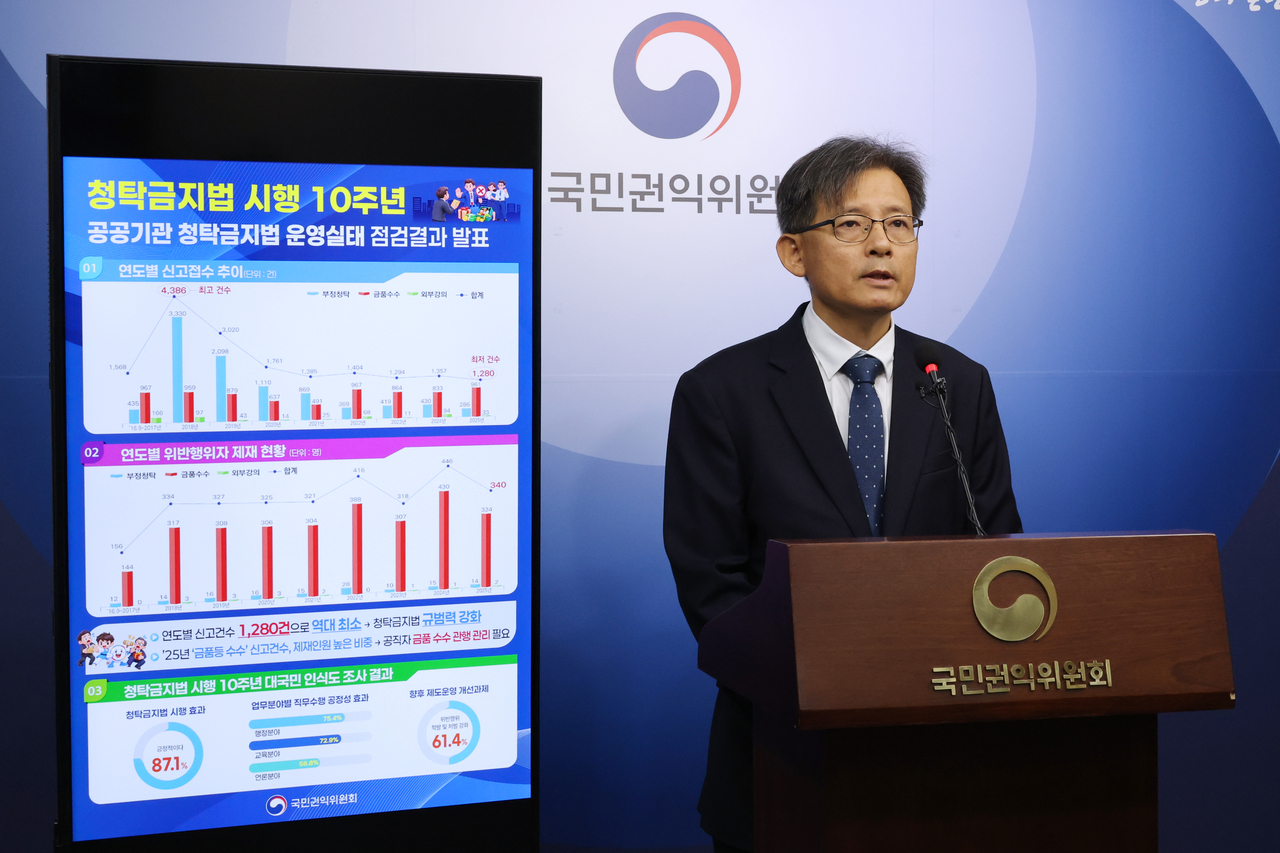
Ten years after South Korea’s antigraft law took effect, reports of suspected violations have reached a record low. But accepting money or valuables remains the leading reason people are sanctioned.
Public institutions received 1,280 reports last year, down from a peak of 4,386 in 2018, the Anti-Corruption and Civil Rights Commission said Monday, on the occasion of the 10th anniversary of the law’s implementation. The number of people sanctioned fell to 340 from 446 in 2024, a decline of 23.8 percent.
Commonly known as the "Kim Young-ran law," the act went into effect on Sept. 28, 2016. It prohibits improper solicitations and restricts the acceptance of money or valuables by people performing public duties.
It applies not only to government officials, but also to employees of schools and media organizations.
The commission reviewed how the law was being administered across some 24,000 institutions, including constitutional bodies, government agencies, local governments, public organizations, schools and educational foundations.
Reports declined from their 2018 peak through 2021, then fluctuated from year to year before reaching last year’s low.
Since the law took effect, public institutions have received a total of 17,455 reports of suspected violations.
Improper solicitations made up the largest share of those reports, at 9,346 cases, or 53.5 percent. Another 7,558 reports, or 43.3 percent, involved the acceptance of money or other valuables.
Payments above the permitted limit for outside lectures and other activities accounted for the remaining 551 reports.
The breakdown of people sanctioned was different from that of reports filed. Of the 2,983 people penalized over the past decade, 2,828 were sanctioned for accepting money or valuables, compared to 140 for improper solicitations and 15 for excessive payments for outside activities.
Last year, money or valuables were involved in 75.1 percent of reports and accounted for 95.3 percent of people sanctioned.
The commission said it would place greater emphasis on such cases and the penalties they carry in briefings for officials responsible for administering the law.
The review also showed how routinely institutions now operate within the system.
Some 99.6 percent had designated an official to handle antigraft matters, with the few exceptions including organizations undergoing dissolution. Additionally, 97.8 percent conducted training at least once a year.
The system did not run without lapses. The commission identified seven cases reported last year in which institutions had failed to complete follow-up steps, including notifications related to administrative fines. It said it had requested corrective action.
In a separate June survey conducted through the government’s People’s Idea Box platform, 87.1 percent of 2,819 respondents rated the law’s effects positively.
Asked whether it had helped make work more impartial, 75.4 percent gave a positive assessment of public administration, followed by 72.9 percent for education and 56.8 percent for the media.
Yet 61.4 percent selected stronger detection and punishment of violations as the top priority for future improvements.
“It is encouraging that both the number of reports and the number of people sanctioned have been declining over the past decade, while public institutions have established stable systems for implementing the law,” ACRC Chair Jung Il-yeon said.
seungku99@heraldcorp.com