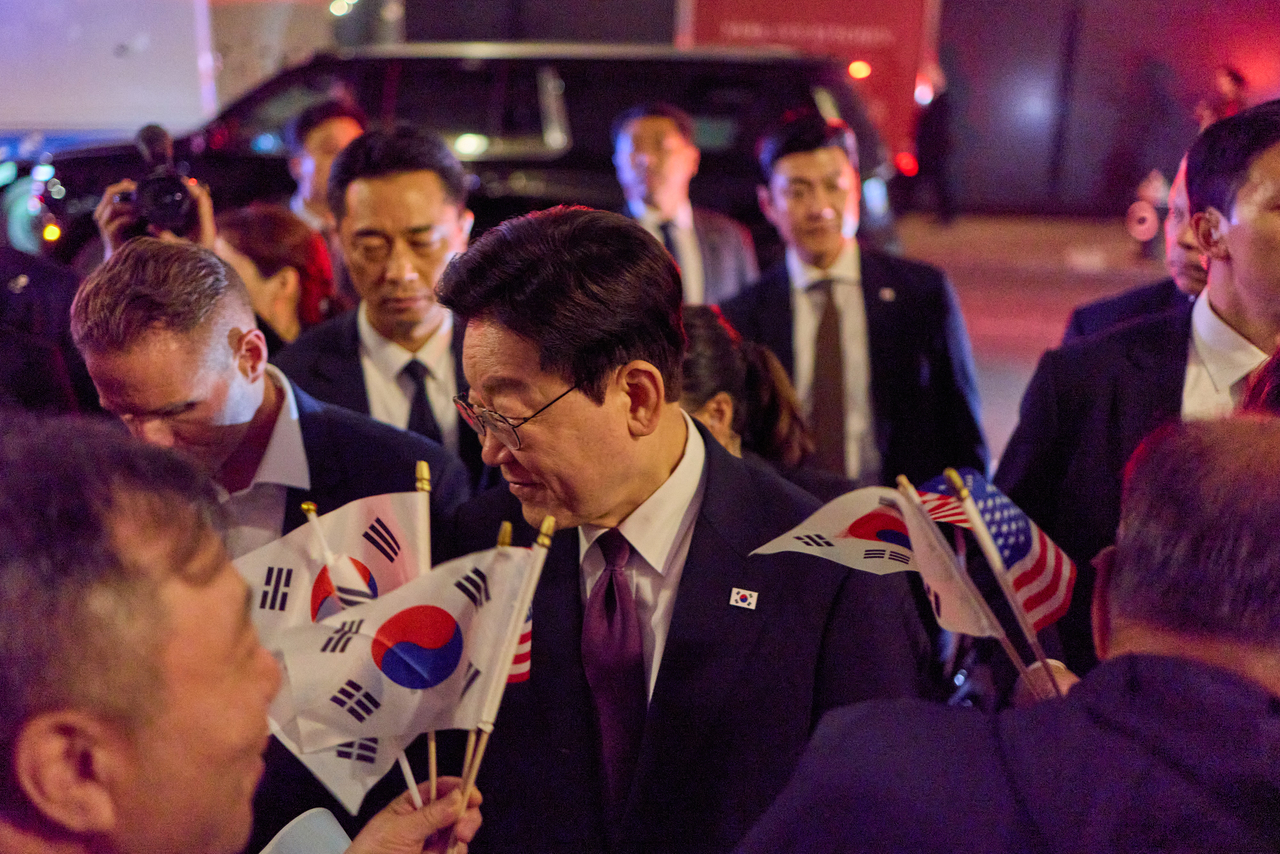
President Lee Jae Myung’s approval rating rebounded for a second straight week following a record low, buoyed by his recent news conference and diplomatic events, according to a poll released Monday.
Support for the ruling Democratic Party of Korea, however, moved in the opposite direction, slipping as intraparty disputes over prosecution reform appeared to erode support among centrists and voters in their 20s, 30s and 40s.
Positive assessments of Lee’s job performance stood at 37.9 percent, up 3.1 percentage points from the previous week, according to the local pollster Realmeter. The previous week had marked the first increase in approval in 10 weeks.
Negative assessments fell 3.3 percentage points to 60.1 percent, while 2 percent of respondents reported being unsure.
Realmeter surveyed 1,508 eligible voters nationwide from Sept. 21 to 23.
Realmeter attributed the rise to his efforts to communicate with the public through his news conference on Sept. 18, as well as his attendance at the UN General Assembly and summit with US President Donald Trump on the margins of it on Sept. 22.
The pollster explained that the withdrawal of Justice Minister nominee Rep. Kim Seung-won, who had been at the center of controversy, and chief of staff Kang Hoon-sik’s offer to resign were seen as signs of Lee’s willingness to pursue a personnel overhaul, contributing to the rise in his approval rating.
By political orientation, Lee’s approval rating rose 4.2 percentage points among centrists to 39.9 percent, with 58.4 percent offering a negative assessment.
Among conservatives, the president's approval rating climbed 3.7 percentage points to 16.3 percent, with 82 percent disapproving.
Regionally, Lee’s rebound was strongest in the ruling party’s traditional stronghold of Gwangju and the Jeolla provinces, where his approval rating surged 13.7 percentage points to 65.5 percent.
Notably, his rating also rose 5.9 percentage points to 36.4 percent in Busan, Ulsan and South Gyeongsang Province, a traditionally conservative region.
However, the gains did not extend to Daegu and North Gyeongsang Province, the country’s other conservative bastion, where his rating fell 2.3 percentage points to 21.9 percent.
Opposition gains amid Cheong Wa Dae woes
In a separate survey of 1,005 voters aged 18 and older conducted from Sept. 22 to 23, the main opposition People Power Party overtook the Democratic Party.
The People Power Party recorded 39.4 percent support, up 0.9 percentage point from the week before, while the Democratic Party fell 1.5 percentage points to 38.7 percent.
The 0.7 percentage-point gap kept the two rival parties within the survey’s margin of error of plus or minus 3.1 percentage points for a sixth consecutive week.
Realmeter attributed the People Power Party’s gain to its “intensified attacks” on the Lee administration’s personnel vetting following the successive withdrawals of Lee’s nominees for justice minister and gender equality and family minister.
The pollster also said the main opposition party benefited from its efforts to highlight controversy over a potential constitutional revision, including debate involving a possible second term for Lee and tensions between Cheong Wa Dae and Supreme Court Chief Justice Jo Hee-de over the appointment of a Supreme Court justice.
The Democratic Party’s decline, meanwhile, appeared to reflect eroding support among voters in their 40s and younger and among centrists, amid internal friction over the nomination of the Serious Crimes Investigation Agency chief and fallout from Jo’s refusal of Cheong Wa Dae’s request to appoint a new justice.
The poll findings came as Lee and the Democratic Party sought to contain signs of friction within the broader ruling bloc.
Ruling bloc rift deepens
Tensions within the party were further exacerbated by public criticism from Rhyu Si-min, a former health minister under President Roh Moo-hyun and a prominent figure in the pro-Roh camp, over Lee’s approach to prosecution reform.
In a lengthy post on X on Sunday, Lee urged supporters to take a more active role in advancing the reform agenda while calling for them to “respond to lies, abusive rhetoric and smear attacks with confident but measured and rational criticism.”
“Even if they come at us in a vulgar manner, let us conduct ourselves with dignity, so that they themselves feel ashamed and the public watching can make its own judgment,” Lee added.
The message came days after Rhyu said during a Sept. 22 YouTube livestream that Lee had “deceived the public” over prosecution reform, criticizing Lee’s approach as different from what the Democratic Party and its supporters had understood the reform to entail.
Democratic Party leader Kim Min-seok on Monday also urged party members to exercise restraint and avoid derogatory language toward others within the broader ruling bloc, pushing back against calls from some members for legal action against Rhyu.
“Just because the other side does something does not mean we necessarily have to do the same,” Kim said. “We also need to exercise restraint if we are to resolve these problems.”
dagyumji@heraldcorp.com