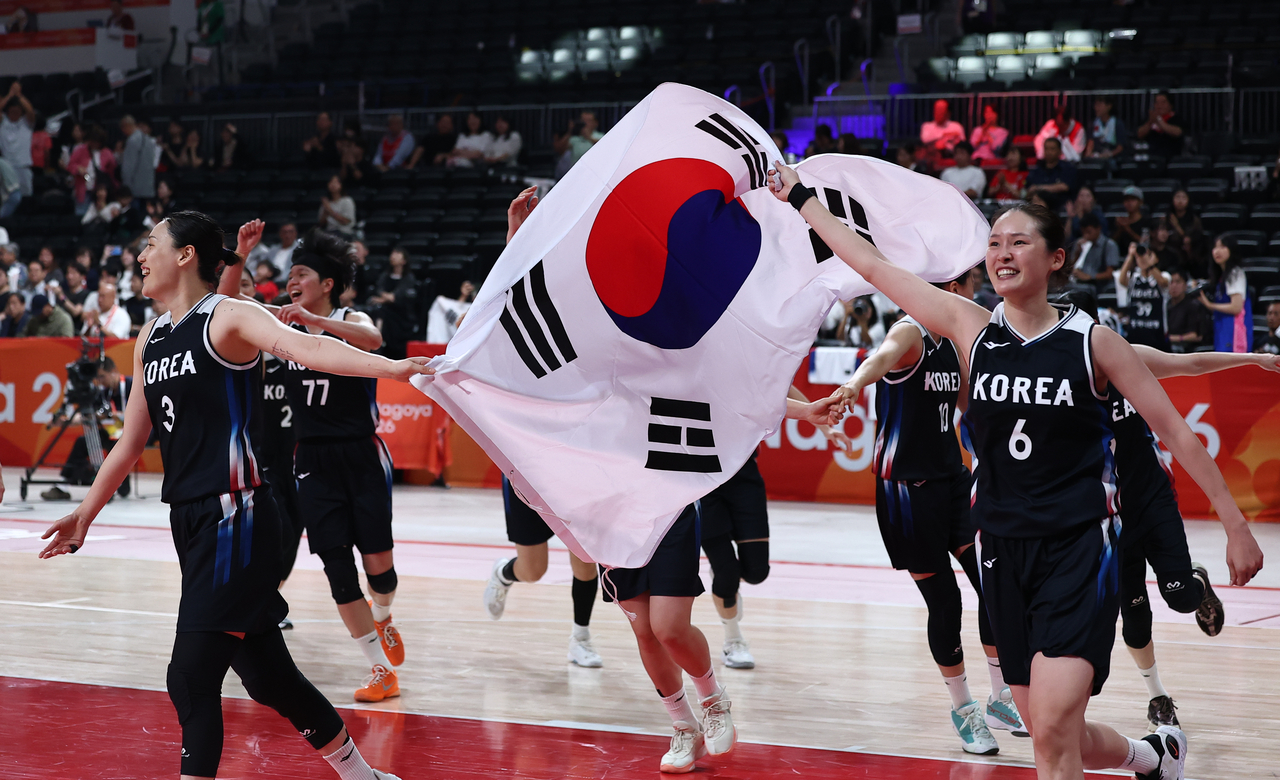
South Korea captured the women's basketball title at the Aichi-Nagoya Asian Games on Saturday with a 75-70 victory over the home team Japan.
Forward Lee Hae-ran led her team with 24 points, and captain Kang Lee-seul added 21 points for the narrow win in the final at Aichi International Arena in Nagoya, central Japan.
This is South Korea's first women's hoops gold since 2014, coming six days after the men's team also beat Japan for gold. This is also South Korea's first sweep of the men's and women's basketball titles at an Asian Games in a dozen years.
South Korea led by as many as 20 points in the third quarter before weathering the late storm.
South Korea responded to the game-opening three by Miyu Okamoto with 11 unanswered points. With a couple of offensive boards setting up easy shots at the rim, South Korea went up 15-3 at the 5:48 mark.
Park So-hee's corner three put South Korea up 25-10 with 52 ticks left in the first quarter, with Japan's late push making the score more respectable at 27-15.
South Korea opened the second quarter with a three-pointer by captain Kang Lee-seul to double up Japan at 30-15. Both teams then hit a dry spell, combining for just five points over the next 5 1/2 minutes, before Lee Hae-ran's three put South Korea up 35-18 at the 4:19 mark.
Japan failed to take advantage of a stretch of poor shooting by South Korea late in the second quarter, and then Park So-hee banked in a buzzer-beating three from well behind the arc for a 42-23 lead at halftime.
South Korea answered Japan's push in the third quarter. With the lead down to 48-34, South Korea scored five straight points and then Kang connected from downtown for a 56-36 advantage at 4:29.
Japan would not go away easily. After Kang's three-pointer restored a 15-point cushion at 63-48, Suzuno Higuchi beat the buzzer with a three of her own to make it a 12-point game entering the last quarter.
Japan then started the final frame on fire, making five of its first seven field goals to cut the South Korean lead to 66-62.
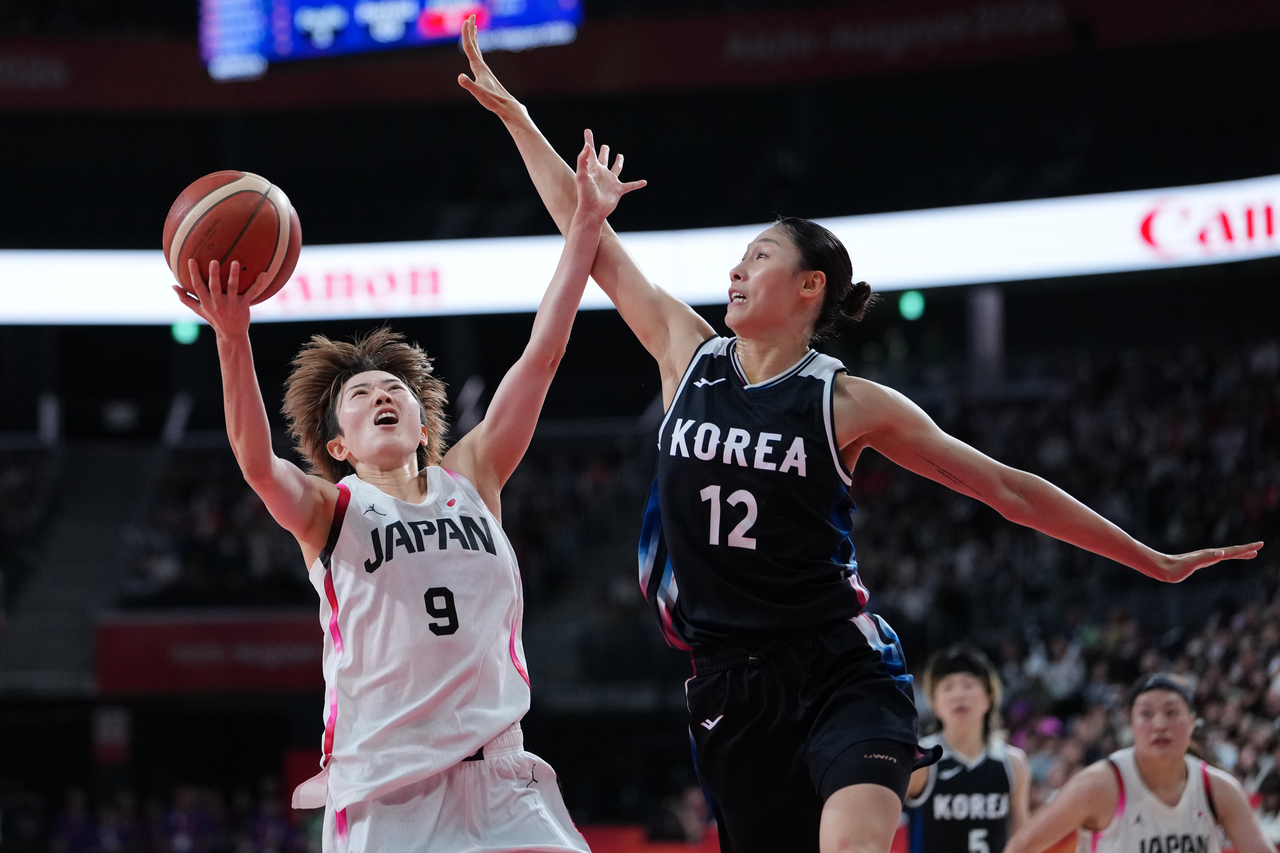
After a timeout, a jumper by Lee So-hee and a drive by Kang gave South Korea some breathing room at 70-62 with five minutes remaining.
Both teams missed some open shots, before a couple of free throws by Haru Owaki made it a 70-66 game with 2:15 left.
Lee Hae-ran made a layup at the other end, but then Owaki responded with a basket for Japan to keep things tight.
South Korea clung to a 72-68 lead with 32.6 seconds left but failed to score in a scrambling possession. And after Riho Akagi missed two free throws for Japan, Owaki grabbed the board and scored an easy bucket, making it a two-point game.
Japan fouled Kang to stop the clock, and the South Korean captain coolly drained both foul shots for a 74-70, a two-possession game with 14 seconds left.
Owaki missed one at the rim in the next possession. Lee Hae-ran, after grabbing the rebound and getting fouled, sank one of her two free throws to push the lead to 75-70.
Higuchi missed a desperation three with the time winding down, and Lee snatched her ninth rebound of the game to seal the win.
South Korea shot 39 percent from downtown and 44 percent overall, while Japan connected on just 21 percent of its attempts from behind the arc and 37 percent overall. (Yonhap)