SK Telecom, KT and LG Uplus offer greater convenience and perks, while lower-cost MVNOs come with trade-offs in support and services
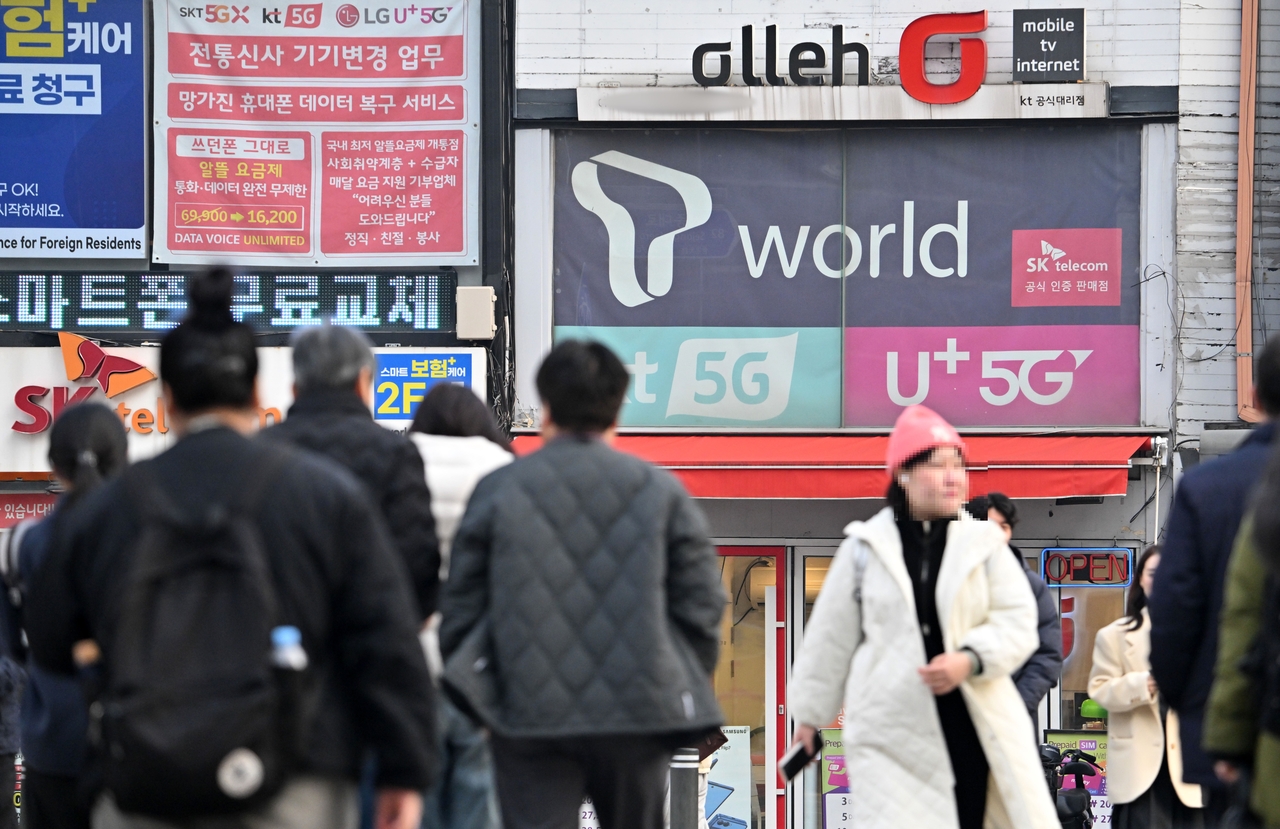
If you have a residence card and a Korean bank account or credit card, you can usually sign up for a long-term mobile plan. The harder question is which kind to choose.
South Korea has three major network operators: SK Telecom, KT and LG Uplus. They offer extensive retail networks, device financing, membership benefits and bundles linking mobile service with home internet and television.
The alternative is a mobile virtual network operator, or MVNO. Known in Korean as “altteulpon,” or budget mobile service, MVNOs lease network access from the three major carriers and sell their own plans, often at considerably lower prices.
For most users, the choice is not about whether calls and data will work. It is about whether the convenience and additional services offered by a major carrier are worth the higher monthly cost.
The big three: Support, bundles and perks
SK Telecom, KT and LG Uplus own and operate the country’s mobile networks. All three provide generally fast and reliable service, particularly in urban areas.
A government assessment released in 2025 found that KT had the fastest average 5G download speed, while SK Telecom performed best in maintaining the speeds required for high-quality services such as video streaming. LG Uplus recorded the highest rate of 5G availability.
The differences, however, are unlikely to be decisive for most ordinary users. All three should provide satisfactory service for browsing, messaging, navigation and video streaming in most populated areas.
What sets the major carriers apart is convenience.
Customers can visit stores for help with opening or canceling an account, replacing a SIM card or changing a plan. English-language assistance varies by location, however, so it may be worth calling ahead or visiting a branch in an area with a large international population.
The three companies also offer handset installment plans, although buying a phone through the carrier is not required. Users can bring a compatible unlocked phone and choose a SIM-only plan.
Major carriers frequently bundle mobile plans with home internet, IPTV or additional family phone lines. Depending on the plan, benefits may include discounts on streaming subscriptions, international roaming, restaurants, cinemas and other affiliated businesses.
Such benefits can make a more expensive plan worthwhile, but only if they are services you would otherwise pay for. Rather than comparing the advertised monthly price alone, calculate the final bill after discounts, device payments and optional services.
Contracts tied to discounted devices or monthly service fees may also involve repayment or penalties if canceled early.

MVNOs: Lower bills, less hand-holding
An MVNO is a type of mobile service, not a special kind of phone. Users can insert an MVNO SIM into a compatible unlocked device, including a flagship Samsung Galaxy or Apple iPhone.
Dozens of MVNO brands operate in Korea, including several affiliated with the major telecommunications companies.
They do not maintain their own network infrastructure or large numbers of retail stores, so they can offer substantially cheaper plans.
Because MVNOs use the networks of SK Telecom, KT or LG Uplus, their basic coverage generally follows that of the host carrier. That does not mean every plan provides an identical experience, however.
Many plans advertised as being unlimited provide a fixed amount of high-speed data each month. Once that allowance is exhausted, data remains available but at a reduced speed. Depending on the plan, that may be sufficient for messaging and web browsing but frustrating for high-quality video streaming or large downloads.
Current MVNO offerings include both LTE and 5G plans, while features such as eSIMs, smartwatch service, data sharing and international roaming are available from some providers. Availability varies considerably, so users should check the conditions of the individual plan rather than assume that all MVNOs offer the same services.
Customer support is another trade-off. MVNOs generally have fewer physical stores, and service may be limited to phone or online channels. Operating hours and foreign-language assistance also vary by company.
What foreign residents should check
Foreign residents can apply for MVNO service using their foreign resident registration number, including through the government-supported MVNO Hub comparison website.
The application process is not identical across providers. Some companies allow foreign residents to apply online but do not permit them to activate the service themselves, requiring assistance from a customer service representative instead.
Applicants may need a residence card and a Korean bank account or credit card. The name entered on the application must match the name registered on the identification and payment records, including spacing and order.
A properly registered postpaid MVNO number can generally be used for mobile identity verification on Korean websites and apps, although users may have to select the MVNO option associated with the underlying SK Telecom, KT or LG Uplus network.
Promotional prices also require close attention. An unusually cheap monthly rate may apply only for the first several months, after which the standard fee takes effect. Some plans may also charge for the SIM card or impose conditions on early cancellation.
Before signing up, compare the regular price, the length of the promotion, the high-speed data allowance, the speed after that allowance is exhausted and the availability of services such as roaming, tethering and data sharing.
Which should you choose?
A major carrier may be the better option if you value in-person support, want to finance a new phone, use large amounts of high-speed data or plan to bundle your mobile service with home internet and other family accounts.
An MVNO is likely to be more economical if you already own a compatible phone, are comfortable handling the application online and mainly want calls, messages and data without additional benefits.
Whichever you choose, compare plans on a like-for-like basis. Check the underlying network, LTE or 5G access, high-speed data allowance, reduced speed after the cap, promotional period and cancellation conditions.
In Korea’s crowded mobile market, the cheapest advertised plan is not always the cheapest in the long run — and the most expensive one is not necessarily the most useful.