- NEWS AND VIEWS
Dust can tint the cosmos red, but a compact astronomical object is coloured by turbulent gas around a black hole.
By
-
Dominik Schleicher
-
Dominik Schleicher is in the Department of Physics, Sapienza University of Rome, Rome 00185, Italy.
-
-
Rodrigo Herrera-Camus
-
Rodrigo Herrera-Camus is in the Department of Astronomy, University of Concepción, Concepción, Chile, and the Millennium Nucleus for Galaxies (MINGAL), Concepción, Chile.
-
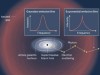
Dust, which is found throughout the Universe, absorbs and scatters blue light more efficiently than it does red, so astronomical objects often look reddened when observed from Earth. The reddening of light by dust underpins most theories about little red dots (LRDs)1,2, which are bright, compact astronomical objects with unknown origins. But now, in a paper in Nature, Naidu et al.3 report the discovery of an LRD with spectral properties that might be explained by a large cloud of dense, ionized gas, rather than dust. The authors argue that if other LRDs are gas-reddened, their true masses might be substantially smaller than previously estimated.
Nature 656, 301-302 (2026)
doi: https://doi.org/10.1038/d41586-026-02290-1
References
Matthee, J. et al. Astrophys. J. 963, 129 (2024).
Article Google Scholar
Labbé, I. et al. Nature 616, 266–269 (2023).
Article PubMed Google Scholar
Naidu, R. P. et al. Nature 656, 329–333 2026.
Article Google Scholar
Akins, H. B. et al. Astrophys. J. 991, 37 (2025).
Article Google Scholar
Escala, A. et al. Astrophys. J. 995, 44 (2025).
Article Google Scholar
Liempi, M. et al. Astron. Astrophys. 708, A44 (2026).
Article Google Scholar
Wilkins, S. M. et al. Mon. Not. R. Astron. Soc. 527, 7965–7973 (2024).
Article Google Scholar
Mortlock, D. J. et al. Nature 474, 616–619 (2011).
Article PubMed Google Scholar
Wang, F. et al. ApJL 907, L1 (2021).
Article Google Scholar
Rusakov, V. et al. Nature 649, 574–579 (2026).
Article PubMed Google Scholar
Latif, M. A. et al. Astron. Astrophys. 694, 8 (2025).
Article Google Scholar
Download references
Competing Interests
The authors declare no competing interests.
Related Articles
-
 Read the paper: A gas-enshrouded and gas-reddened black hole at cosmic dawn
-
 Mysterious ‘little red dots’ could be black holes in disguise
-
 Galaxy found napping in the primordial Universe
-
See all News & Views
Subjects
Latest on:
- Astronomy and astrophysics
-
Evidence for the first globular cluster stellar stream beyond the Milky Way
Article
-

A gas-enshrouded and gas-reddened black hole at cosmic dawn
Article
-

Numerous bow shocks in the outer Helix Nebula
Article