- WORLD VIEW

From southern Africa to the Amazon, the risks are mounting and the window for action is rapidly closing.
By
-
Zeke Hausfather
-
Zeke Hausfather is a climate scientist at the non-profit research organization Berkeley Earth in Berkeley, California, and the climate research lead at the financial-technology company Stripe.
-

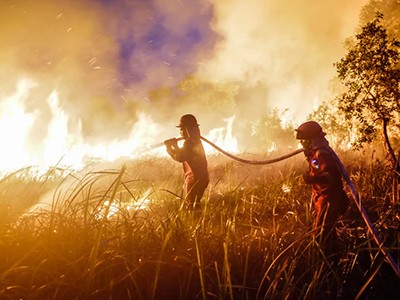
Peatland fires in Indonesia, which can be exacerbated by El Niño, release a huge amount of carbon dioxide.Credit: Sigit Prasetya/NurPhoto via Getty
As a climate scientist who studies land and ocean temperature records, I start each day by pulling observations and forecasts of the El Niño weather pattern from 14 leading models into a real-time dashboard. For the past few months, the numbers have been nothing short of extraordinary.
The super El Niño is already wreaking havoc: here’s what’s in store
In early September, sea surface temperatures in the central tropical Pacific Ocean were about 2.9 °C above the current climate baseline (the average for the past 30 years). That is more than 1 °C warmer than at the same stage of the powerful 1997 and 2015 El Niño events. Forecasts now suggest a more than 90% chance that this year’s event will surpass every El Niño since observations began in the 1870s.
El Niño events do not affect every region of the world in the same way, but their broad impacts are well understood. The phenomenon can bring drought and failed harvests to some areas, and floods to others; fuel wildfires in dried-out forests and peatlands; and drive coral bleaching in overheated oceans. Agencies ranging from national agriculture ministries to the World Health Organization must start preparing immediately to mitigate these risks.
One of the clearest and most consistent impacts of El Niño is drought in southern Africa. During the four strongest El Niño events between 1980 and 2016, the region faced roughly an 80% chance of below-normal rainfall during the December–February wet season. Even the comparatively moderate 2023–24 El Niño triggered severe drought, prompting disaster declarations in Zimbabwe, Zambia and Malawi, and reducing the Zambezi River to its lowest recorded flow. South Africa’s maize (corn) harvest fell by nearly half during the 2015–16 El Niño event. With the planting season beginning in October, governments have only a few weeks to act. Priorities include distributing drought-tolerant and early-maturing crop varieties in high-risk areas and expanding programmes that provide support when harvests fail, similar to measures used in Ethiopia during the 2015–16 drought.
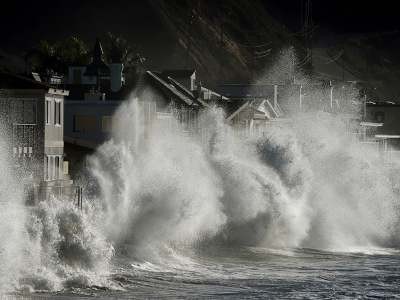
This El Niño is set to be the largest on record by a ‘mind-blowing margin’
Some impacts are already visible. Rainfall is declining across Indonesia, boosting the risk of peatland fires. During the 1997 El Niño, Indonesian fires emitted an estimated 3–9 gigatonnes of carbon dioxide, equivalent to roughly 13–40% of global fossil-fuel emissions that year. Fires and haze resulting from the 2015 El Niño were linked to around 100,000 excess deaths across Indonesia, Malaysia and Singapore. The Indonesian government has taken important steps to reduce these risks, including establishing a peatland restoration agency and restricting the clearing of primary forests and peatlands. But the danger remains high, making early prevention and preparedness essential.
Nature 657, 858 (2026)
doi: https://doi.org/10.1038/d41586-026-02939-x
Competing Interests
The author declares no competing interests.
Related Articles
-
 The super El Niño is already wreaking havoc: here’s what’s in store
-
 This El Niño is set to be the largest on record by a ‘mind-blowing margin’
-
 A ‘super’ El Niño could transform the Amazon. Is the world’s biggest rainforest doomed?
-
 Are we really headed for a ‘super’ El Niño? What the science says
Subjects
Latest on:
- Climate sciences
- Policy
- Agriculture
-
A global safety net for climate-risk intelligence is urgently needed
Correspondence
-
Losing your way of life to climate change matters — and we need a way to measure it
World View
-
Why Nepal floods resulted in a disaster even after satellites spotted danger
Correspondence
-
Biosecurity must protect human functional capacity
Correspondence
-
A global safety net for climate-risk intelligence is urgently needed
Correspondence
-

Six principles for supporting academic freedom in universities
Comment
-

CRISPR crops are coming to Europe — why bolder would be better
World View
-
Heatwaves expose weak links in food systems
Correspondence
-
Food systems transformation would reshape global agriculture
Article