- NEWS AND VIEWS
Scientists have long dreamt of being able to track and analyse each step in the assembly of a virus’s protein shell. An ingenious experiment shows how this can be done.
By
-
Charlotte Uetrecht
-
Charlotte Uetrecht is at the Centre for Structural Systems Biology, Deutsches Elektronen-Synchrotron (DESY) and the Leibniz Institute of Virology and the University of Lübeck, 22607 Hamburg, Germany. She is also at the Institute of Chemistry and Metabolomics, University of Lübeck, Lübeck, Germany.
-
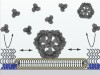
Imagine watching a simple building being constructed from identical blocks. The blocks are assembled by interacting through tiny contact areas and can move with respect to each other during assembly, yet the fully formed structure is stable and rigid. Nevertheless, the completed construction can come apart in response to a trigger. Viruses have protein shells that assemble and behave in this way — protecting the viral genome and then releasing it during the infection of a cell. Observing the assembly of these shells has been difficult, and measuring the kinetics and energetics of the process to deduce the underlying principles of the process has been even harder. Writing in Nature, Asor et al.1 report a method that has achieved all of this for a virus-like particle (VLP), a system that replicates the shells of natural viruses.
Nature 657, 606-608 (2026)
doi: https://doi.org/10.1038/d41586-026-02644-9
References
Asor, R., Loewenthal, D., Melnyk, D., Tan, T. K. & Kukura, P. Nature 657, 653–660 (2026).
Article Google Scholar
Caspar, D. L. D. & Klug, A. Cold Spring Harb. Symp. Quant. Biol. 27, 1–24 (1962).
Article PubMed Google Scholar
Zlotnick, A. J. Mol. Biol. 366, 14–18 (2007).
Article Google Scholar
Hitchcock, A. M., Kufel, W. D., Mastro Dwyer, K. A. & Sidman, E. F. Int. J. Antimicrob. Agents 63, 107009 (2024).
Article PubMed Google Scholar
Dykeman, E. C. Proc. Natl Acad. Sci. USA 111, 5361–5366 (2014).
Article PubMed Google Scholar
Marchetti, M. et al. Nano Lett. 19, 5746–5753 (2019).
Article PubMed Google Scholar
Lutomski, C. A. et al. J. Am. Chem. Soc. 140, 5784–5790 (2018).
Article PubMed Google Scholar
Asor, R., Schlicksup, C. J., Zhao, Z., Zlotnick, A. & Raviv, U. J. Am. Chem. Soc. 142, 7868–7882 (2020).
Article PubMed Google Scholar
Garmann, R. F., Goldfain, A. M. & Manoharan, V. N. Proc. Natl Acad. Sci. USA 116, 22485–22490 (2019).
Article PubMed Google Scholar
Uetrecht, C. et al. Phys. Chem. Chem. Phys. 12, 13368–13371 (2010).
Article PubMed Google Scholar
Download references
Competing Interests
The author declares no competing interests.
Related Articles
-
 Read the paper: Molecular-level observation of the self-assembly of a virus-like particle
-
 How does the spliceosome dismantle itself?
-
 Step-by-step assembly of a β-barrel protein in a bacterial membrane
-
See all News & Views
Subjects
Latest on:
- Physical chemistry
- Biophysics
-
Probing far-from-equilibrium dynamics of electrical double layers
Article
-
Selectivity emerges from indiscriminate photoreduction
Article
-
Graphene oxide-polydopamine membranes with controlled interlayer spacing
Article
-
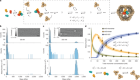
Molecular-level observation of the self-assembly of a virus-like particle
Article
-

Breaking timescales with generative sampling of conformational transitions
Article
-
TM184C is a GPCR-like regulator of intercellular exchange and autophagy
Article