- POLICY BRIEF
Across five randomized trials in India, Kenya, Nepal, the Philippines and Uganda, weekly 20-minute mobile-phone-call tutorials produced large learning gains for primary-school children during school closures caused by the COVID-19 pandemic. Governments can keep children learning through societal shocks using this approach, which combines low-cost, high-access mobile-phone technology with high-quality tutoring targeted to each child’s learning level.
By
- Micheal Ainomugisha1,
- Peter Bergman2,
- Colin Crossley3,
- Claire Cullen4,
- Thato Letsomo5,
- Moitshepi Matsheng6,
- Rene Marlon Panti7,
- Shwetlena Sabarwal8 &
- …
- Tim Sullivan9
-
Noam Angrist
-
Noam Angrist is at the University of Oxford and What Works Hub for Global Education, Oxford, UK, and at Youth Impact, Gaborone, Botswana.
-
-
Micheal Ainomugisha
-
Micheal Ainomugisha is at Building Tomorrow, Kampala, Uganda.
-
-
Peter Bergman
-
Peter Bergman is at the University of Texas at Austin, Austin, Texas, USA.
-
-
Colin Crossley
-
Colin Crossley is at Youth Impact, Gaborone, Botswana.
-
-
Claire Cullen
-
Claire Cullen is at Youth Impact, Gaborone, Botswana, and at What Works Hub for Global Education, Oxford, UK.
-
-
Thato Letsomo
-
Thato Letsomo is at Youth Impact, Gaborone, Botswana.
-
-
Moitshepi Matsheng
-
Moitshepi Matsheng is at Youth Impact, Gaborone, Botswana.
-
-
Rene Marlon Panti
-
Rene Marlon Panti is at Innovations for Poverty Action, Manila, the Philippines.
-
-
Shwetlena Sabarwal
-
Shwetlena Sabarwal is at the World Bank, Washington DC, USA.
-
-
Tim Sullivan
-
Tim Sullivan is at NewGlobe, Nairobi, Kenya.
-
Source research: Angrist, N. et al. Mobile education builds resilience during shocks in five countries. Nature https://doi.org/10.1038/s41586-026-10990-x (2026).
Messages for policy
• Education systems can be made more resilient by building mobile-phone tutoring into emergency responses, to ensure that learning continues when schools are closed because of disease, conflict or climate shocks.
• Prioritize live phone-call tutoring over text messages alone: calls worked in every country, whereas message-only support helped only in countries with long school closures.
• Deliver through government teachers with confidence: gains were as large under government guidance as when delivered by non-governmental organizations, showing that the approach can be scaled in public systems.
• Expect the largest returns where closures are longest and alternatives fewest. However, the low cost of US$11 per child makes phone tutoring attractive even outside emergencies.
The policy problem
Emergencies often close schools. Disease outbreaks, conflict and climate events disrupt education for at least 200 million children annually1. Emergency school closures worsen an existing learning crisis in which less than half of primary-school-age children (around 6–14 years old) in low- and middle-income countries can read a simple story or do basic arithmetic2. When classrooms close, education systems need alternative ways to keep children learning that are cheap, quick to deploy and workable across various settings. Yet rigorous evidence on which approaches work during emergencies is scarce, and programmes that succeed as small pilots often fail when scaled across contexts3 and when delivered by government systems. Proven, affordable tools that sustain learning across contexts when schooling is disrupted are needed.
The findings
Weekly phone-call tutorials that covered basic numeracy skills targeted to each child’s level produced large learning gains across five countries: India, Kenya, Nepal, the Philippines and Uganda. On average, students learnt roughly three times more when they received phone calls tailored to their learning levels alongside weekly text messages containing numeracy content than with the average effective education intervention. At about US$11 per child for eight weeks of instruction, the phone-call approach yields gains of 3.6 high-quality years of schooling per $100 spent, ranking in the top-ten most-cost-effective educational interventions in a review4. Text-message-only interventions worked in settings with the longest school closures, but had inconsistent effects elsewhere, revealing that phone calls are probably necessary to achieve effective results across contexts consistently. Crucially, learning gains from phone-call tutorials delivered by government teachers were as large as those provided by instructors from non-governmental organizations, demonstrating that the programme is scalable in government systems.
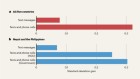
Compared with a proof-of-concept trial in Botswana5, the learning gains and the implementation of the phone-call tutorials improved over time: the trials in Uganda and the Philippines, which were the last of the trials, showed the largest educational improvements (Fig. 1). This improvement was probably due to the detailed monitoring data and mechanisms used, which enabled implementers to learn from experience and improve delivery over time. Results also indicate that learning assessments conducted over the phone were robust, providing a low-cost, easy-to-deploy approach at scale.

Figure 1 | Mobile-phone-based education can promote learning continuity during schooling disruptions. a, b, Each country’s average gain (and 90% confidence intervals) in learning, relative to that country’s control group, that is attributable to weekly 20-minute phone-call tutorials and weekly educational text messages (a) or weekly educational text messages alone (b). The countries in which trials were conducted are shown in chronological order from left to right. Improvements were seen in the average learning level gained from combined phone-call and text tutorials across trials (reflected by the nonlinear curve); learning gains from text messages alone were mixed. Learning levels refer to the number of mathematical operations that students could perform after the educational intervention, with each operation (addition, subtraction, multiplication and division) scored as an extra level gained. Grey shading represents the 90% confidence band of the trend in effects across countries; the dashed grey line through 0 indicates no treatment effect (used as a benchmark).Credit: Angrist, N. et al./Nature (CC BY 4.0)
The study
We ran five coordinated randomized controlled trials in India, Kenya, Nepal, the Philippines and Uganda. These included roughly 16,900 primary-school children (covering students in grades 1–5; aged 6–11 years) who were out of school during closures in 2021–22 because of the COVID-19 pandemic. Families were randomly assigned to a comparison group that received business-as-usual interventions according to the nation’s education system; to a group that receive weekly educational text messages; or to a group that received weekly text messages plus eight weeks of 20-minute phone-call tutorials.
During the phone calls, tutors used simple, frequent assessments to pitch each lesson to the child’s actual learning level rather than to their school grade. In Nepal and the Philippines, we also randomized whether government teachers or non-governmental instructors delivered the calls, directly testing whether the model works in government systems. Our five-country study provides evidence that is not only relevant to each context, but also supports a broader generalizability of the interventions’ effects across diverse settings. We assessed the robustness of measuring learning remotely over the phone, enabling real-time measurement of educational outcomes during disruptions.
doi: https://doi.org/10.1038/d41586-026-02700-4
Funding statement We thank the UBS Optimus Foundation, Mulago Foundation, Douglas B. Marshall Foundation, Echidna Giving, Stavros Niarchos Foundation, Jacobs Foundation, JPAL IGI, Northwestern’s ‘Economics of Nonprofits’ class, the Peter Cundill Foundation and the World Bank. C. Cullen received funding from the UKRI GCRF and Oxford’s OPEN Fellowship.
References
Education Cannot Wait. Global Estimates: Number of Crisis-Affected Children and Adolescents in Need of Education Support (Education Cannot Wait, 2022). This report establishes the scale of the problem: an estimated 222 million children face regular schooling disruptions and need education-in-emergencies support.
Google Scholar
World Bank. World Development Report 2018: Learning to Realize Education’s Promise (World Bank, 2018). This report documents the global learning crisis that our programme targets: although many more children around the world now attend school, learning levels in many low- and middle-income countries remain low and stagnant.
Google Scholar
List, J. A. Nature 626, 491–499 (2024). This paper highlights the importance of scaling across contexts, by documenting the common ‘voltage drop’ in an intervention’s effect when pilot studies fail to scale up.
Article PubMed Google Scholar
Angrist, N. et al. J. Dev. Econ. 172, 103382 (2024). This review introduces a global cost-effectiveness benchmark — learning-adjusted years of schooling across roughly 200 interventions — that ranks phone tutoring in the top ten.
Article Google Scholar
Angrist, N., Bergman, P. & Matsheng, M. Nature Hum. Behav. 6, 941–950 (2022). This paper provides a proof-of-concept trial for phone-call tutoring in Botswana.
Article PubMed Google Scholar
Download references
Competing Interests
N.A. and M.M. co-founded Youth Impact, the non-governmental organization that first developed and tested the ConnectEd phone tutoring programme evaluated in this study. C. Cullen heads Youth Impact’s research team. Youth Impact provided training and technical assistance to implementing partners across the five trials but did not itself deliver the intervention in the study countries and received no financial benefit contingent on the study’s findings. All other authors declare no competing interests.
Related Articles
-
 Read the paper: Mobile education builds resilience during shocks in five countries
-
 Phone-based tutoring improves learning during school closures
-
 Marriage of adolescent girls in Nigeria reduced by 80% by ‘big push’ intervention
-
 School smart or street smart? Maths skills of children in India tested
Subjects
Latest on:
- Policy
- Education
-

Why we need an International Panel on Inequality
Comment
-
Nepal disaster is a wake-up call to take compound climate risks seriously
Correspondence
-
Sideline vested interests to reform China’s research
Correspondence
-

Use AI as a sparring partner, not an oracle
World View
-
Phone-based tutoring improves learning during school closures
News & Views
-

Pick up the phone! Phone calls with tutors keep kids learning when schools shut down
News